

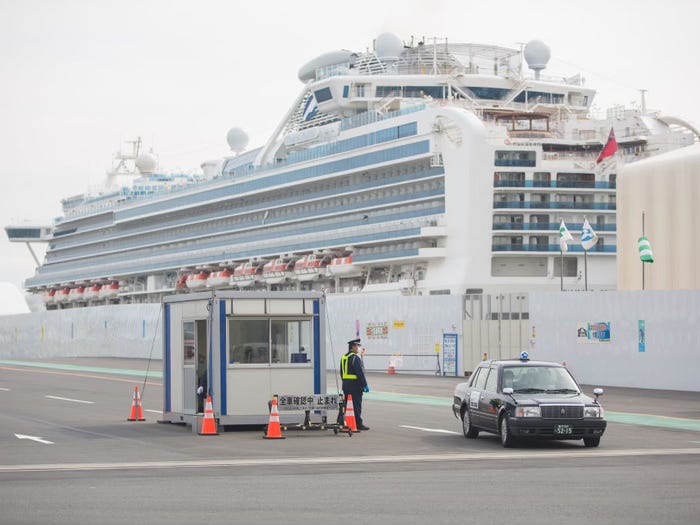
While the quarantines imposed in China were the most draconian of the early attempts to stop the virus, the other early quarantine event of note was the traditional kind, the quarantine of the half-billion-dollar luxury cruise ship the Diamond Princess, which was quarantined in Japan’s Yokohama harbor on February 4, 2020, after a passenger who disembarked in Hong Kong on February 1 tested positive for Covid-19. Passengers were told to stay in their cabins on February 5 while crew remained free to move around the ship. Most of the passengers remained on the ship had to stay on it. On February 20 the WHO announced that more than half the known cases in the world of Covid-19 outside of China were on the Diamond Princess. The final group only left the ship on March 1, and many faced additional quarantine on dry land. In the period spent on board, over seven hundred passengers and crew caught the disease.[i] In addition to its role as a dystopian metaphor for mobile luxury gone wrong, the ship also acted as a massive science experiment. Various academic papers in the months following the ship’s quarantine noted that the spread of the disease did appear to slow when passengers were confined to their cabins. Staff who moved between cabins to feed the passengers continued to spread the disease. This suggested that long-range transmission through air conditioning systems was not a major problem, and that the disease was likely to be spread between people who were close to each other.[ii] The Diamond Princess was also a model of a different kind, of the politics of turbulent mobilities. As the ship is a luxury cruise ship, most of the passengers were paying for that luxury. While they were divided into classes with different sized cabins, some with balconies, they were all able to pay for the ticket, and they were who were immobilized. Most were from Japan and the United States. The people moving around the ship and between cabins were the crew. The crew too, had a hierarchy. An account in Wired tells the story of Alex (not his real name), an Asian worker on the boat: “On board, Alex noticed that, among the crew, the navigation team tended to come from Western countries. Their cabins were on higher decks. Some officers were allowed to eat in the passenger dining rooms and run on treadmills in the passenger gym. Housekeeping and food workers largely came from the Philippines, India, and Indonesia and most slept below the waterline in cramped cabins with roommates.”[iii] It was these workers who prepared and delivered food as well as linens and medications to the passengers. As the quarantine period came to an end, the US citizens who did not test positive were let off first and flown back to the United States on specially prepared flights. Others left four days later. The crew were then told they had to quarantine for a further fourteen days as they had not isolated earlier. Of the 712 people who contracted Covid-19 on the ship, fourteen later died of Covid-19-related problems.
While there is a logic to quarantines and lockdowns on confined spaces such as a ship or small island, the logic becomes far more tenuous at the scale of a subcontinent. On March 24, 2020, a nationwide lockdown came into force in India, a country of 1.4 billion people. The lockdown was announced four hours in advance. While the lockdown produced inconveniences for the relatively well off, as it did in other countries, it was a nightmare for the millions of migrant workers and other laborers in the informal sector of the economy. There were no homes for them to go to where they could practice “social distancing.” In many cases their homes were places of insecurity and threats to health. In addition, on March 24, millions of these workers were nowhere near their homes but hundreds of miles away working on constructing the shiny new buildings of India’s booming economy. Lockdowns are designed to limit mobility and thus the spread of the virus. In an economy like India’s, reliant on migrant and informal labor, lockdown meant suddenly increased mobility as millions took to the road to return home. The lockdown in India was superimposed on existing patterns of migrant mobilities where “most men migrate from around August to May after the monsoon planting season to earn a living in factories, construction sites and other businesses.”[iv] Workers suddenly without jobs lined up for miles at the Anand Vihar bus station outside of Delhi in the hope of catching buses that were not there. Many tried to hitch rides on trucks. Many walked or cycled over a hundred miles to get home. The lockdown filled the roads with what was effectively a forced migration. Many of these workers returned either on foot or in trucks to poorer rural states such as Andhra Pradesh and Karnataka without wages that were due or any prospect of future employment. They were crowded together and likely to be infectious. As Frédéric Landy and Camille Noûs wrote:
COVID-19 abruptly revealed the lives of all these shadowy workers, showing them to be either victims whose economic fragility was suddenly discovered or confirmed, or a threat, since trudging along roads without respecting “social distancing” they risked spreading the virus. A priori, the injustice against them thus appears to have two facets: they have suffered most from the lockdown; but even before the crisis, their invisibility prevented any real recognition of their rights.[v]
The invisibility of the migrant worker population is, in part, a result of a sedentarist metaphysics and politics in action. The attribution of certain kinds of rights and the fullest kinds of citizenship are based on territorial units within which rights can be exercised. For instance, during Covid-19 lockdowns, people in India were theoretically provided with a minimal ration of food (rice, dal, and oil). Each person, however, was told a specific site, near their recorded home, where this could be picked up. This process made no sense to the millions of migrants who were nowhere near their recorded home.
Hence many flows are based on regional development differentials that provide a non-negligible income to migrants in normal times, but which are proving to be sometimes death traps during the COVID-19 crisis since . . . the few social rights that exist in India apply above all to sedentary people, officially registered in a place. The closure of internal borders made it impossible for migrants to regain the benefits and rights of their full citizenship in their places of origin, without the “house arrest” of lockdown being paradoxically possible in the place of immigration.[vi]
In addition, the “place of origin” in the Indian subcontinent is likely to be a very different place from the place of employment, with a different language and customs. This made it very difficult for migrant workers to negotiate their way out of their predicament or to explain it to the police who were monitoring the lockdown. The migrant population, in other words, became shadow citizens, or for our purposes here, vagabonds. As Landy and Noûs argue:
At a deeper level, the non-recognition by the State of this social group, its “invisibilisation,” has been generated through its attachment to territorialised public policies. Not only can migrants no longer cross district and state borders, they cannot even enjoy their rights because they are not de jure attached to a space, even though the lockdown blocks them there de facto. . . . . Migrants suffer from political and administrative divisions of space which do not correspond to their space of circulation. By definition, they are caught between two places: they therefore tend to fall outside the ambit of the highly territorialized state rationales. And given this strong spatialization of social rights, they were already marginalized even before COVID-19.[vii]
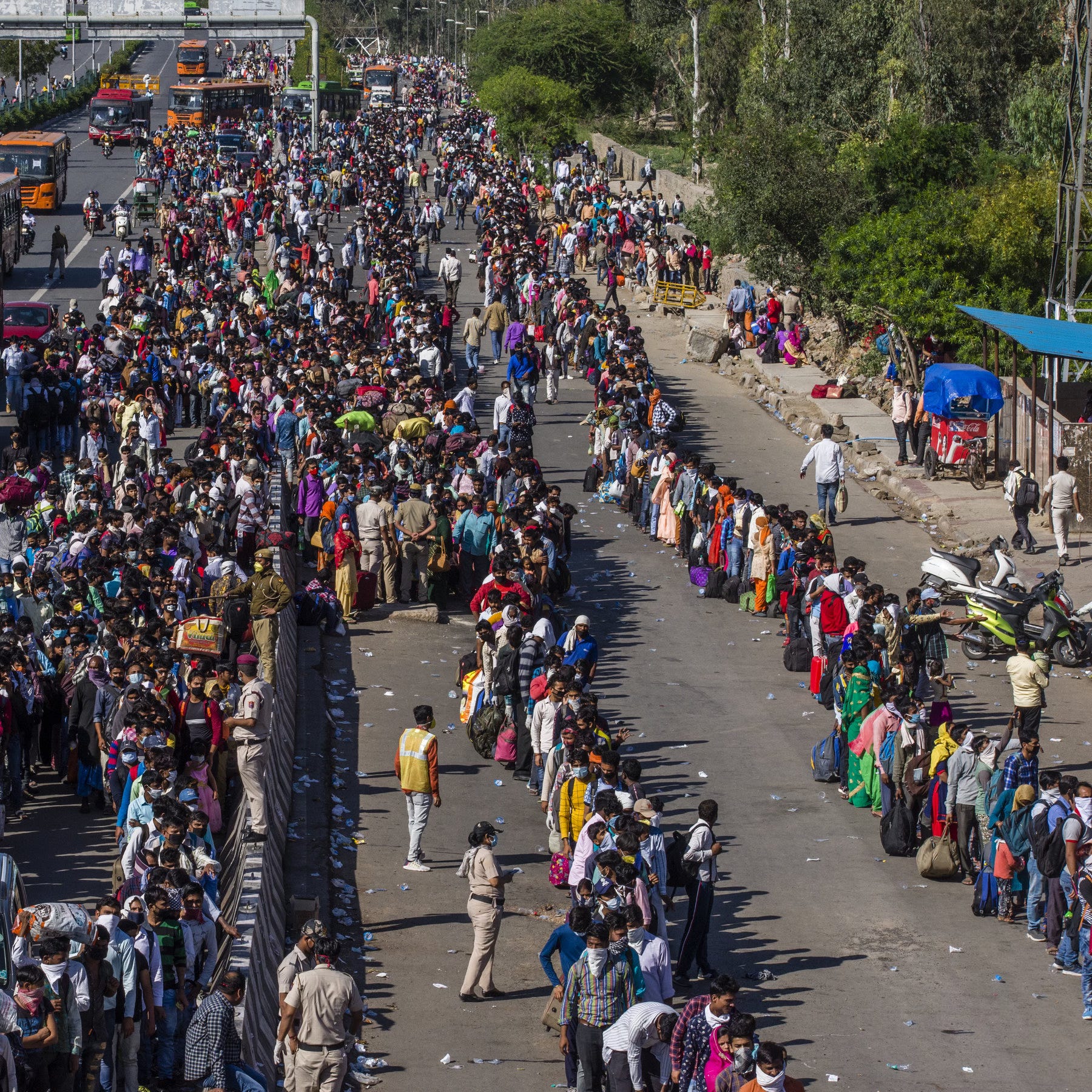
It was onto this landscape of migratory circulation that the lockdown policy was imposed on March 24, 2020. At the same time, around a thousand people a day were dying of tuberculosis when the lockdown was introduced. There were all kind of problems being faced by India’s poor that were more pressing than the 147 people who had died of Covid-19 at that point. Some would die trying to get home. As geographer Krithika Srinivasan put it, “A lockdown adversely affects the vast majority of people for whom this novel coronavirus is a smaller risk when compared to more serious and immediate issues such as hunger, domestic violence or eviction.”[viii] Srinivasan described the lockdown policy as one that traveled poorly from Western countries to a place like India. She labeled the lockdown as a TINA (there is no alternative) response.[ix] The lockdown model, and the accompanying practice of “social distancing,” Srinivasan argues, were developed in the Global North by and for people who were not used to feeling threatened by contagious disease. They were developed to “flatten the curve” and prevent the medical system from becoming overloaded with Covid-19 cases. Even in the Global North, she notes “they are public health measures that benefit only a minority of the population—those who have salaried jobs, savings, fridges large enough to stockpile groceries, homes that are spacious enough to remain indoors without confinement becoming a health problem in and of itself.”[x]Clearly, she argues, social distancing is not an option in a crowded home in India (or anywhere else). The lockdown in India is likely to have exacerbated the spread of the disease among the poor while giving some comfort to the relatively wealthy. Indeed, to the wealthy, the poor are part of the threat that needs controlling—suspected vectors for the spread of the disease. The idea that “there is no alternative” to lockdown may well “flatten the curve,” Srinivasan argues, but it also “skews the curve,” making the poor and otherwise vulnerable more likely to catch the virus and more likely to die. Lockdowns, in other words, protect some people while making the lives of the already vulnerable even more vulnerable. It separated citizens from vagabonds:
[i] Mario Koran, “From Paradise to Coronavirus: The Grand Princess and the Cruise from Hell,” The Guardian, March 14, 2020, https://www.theguardian.com/world/2020/mar/13/from-paradise-to-coronavirus-the-grand-princess-and-the-cruise-from-hell.
[ii] Pengcheng Xu, Hua Qian, Te Miao, Hui-Ling Yen, Hongwei Tan, Min Kang, et al., “Transmission Routes of Covid-19 Virus in the Diamond Princess Cruise Ship,” medRxiv (April 14, 2020); Kenji Mizumoto and Gerardo Chowell, “Transmission Potential of the Novel Coronavirus (COVID-19) Onboard the Diamond Princess Cruise Ship, 2020,” Infectious Disease Modelling 5 (2020).
[iii] Lauren Smiley, “27 Days in Tokyo Bay: What Happened on the Diamond Princess,” Wired, April 30, 2020, https://www.wired.com/story/diamond-princess-coronavirus-covid-19-tokyo-bay/ (accessed May 23, 2023).
[iv] Nitya Rao, “India’s Coronavirus Lockdown Will Hit Women and Migrant Workers Hardest,” The Conversation, March 26, 2020, https://theconversation.com/indias-coronavirus-lockdown-will-hit-women-and-migrant-workers-hardest-134689 (accessed May 24, 2023).
[v] Frédéric Landy and Camille Noûs, “What Covid-19 Tells Us About Spatial Injustices in India,” Justice spatiale/Spatial Justice 15 (September 2020), http://www.jssj.org/article/ce-que-nous-dit-la-covid-19-des-injustices-spatiales-en-inde/?lang=en.
[vi] Landy and Noûs, “What Covid-19 Tells Us About Spatial Injustices in India.”
[vii] Landy and Noûs, “What Covid-19 Tells Us About Spatial Injustices in India.”
[viii] Krithika Srinivasan, “Lockdown Protects the Well-Off, but What About Those Who Face Hunger, Homelessness or Poor Health?,” The Hindu, April 18, 2020, https://www.thehindu.com/society/lockdown-protects-the-well-off-but-what-about-those-who-face-hunger-homelessness-or-poor-health/article31373630.ece.
[ix] Krithika Srinivasan, “How Health Inequalities Are Made: The TINA Response to Covid-19,” MedEnv Network: Intersections in Medical and Environmental Humanities, May 24, 2020, https://medenvnetwork.files.wordpress.com/2020/06/health-inequalities-covid-tina-lockdown.pdf.
[x] Srinivasan, “How Health Inequalities Are Made.”