
Distance is the Wrong Measurement
What Vancouver's local food scene taught me about what "local" really means.

I was sitting in a restaurant in Vancouver looking at a six-course tasting menu. The opening course featured “sake kasu aged burdock” alongside “aged sake kasu butter.” The sake kasu — fermented rice solids extracted to clarify sake comes from Vancouver’s own sake producer, a Japanese immigrant who grows his rice at Canada’s only rice paddies in nearby Abbotsford, the most northerly rice paddies in the world. The burdock comes from a farm in the Fraser Valley and has been aged for a year in the sake lees. Chef Andrea Carlson had built an entire menu out of relationships with people she had known for thirty years. Her definition of what counts as local, she told me, “is defined by the relationship.” The restaurant, Burdock & Co, would be awarded a Michelin star the following year — a global accolade for a local vision.
I had come to Vancouver to interrogate the meaning of the word “local” from that expensive tasting menu out to valley farms, farmers’ markets, and community food hubs. My guide was J.B. MacKinnon, one of the inventors of the 100-Mile Diet. In 2005, MacKinnon and his partner Alisa Smith began eating only foods sourced within 100 miles of their Vancouver home, recording the experiment first in a blog, then a book, then a television series. The 100-Mile Diet became a touchstone of the locavore movement, spawning farmers’ market expansions, restaurant manifestos, and a new vocabulary for thinking about the ethics of eating.
The phrase that stayed with me from MacKinnon’s writing was simple and arresting: “distance is the enemy of awareness.” I met him at an outdoor bench at a plaza reclaimed from traffic during the Covid lockdowns. He still eats 85% locally but is not a zealot. “I don’t believe we should have no trade outside our foodshed,” he told me. “I just think the orientation, the balance, is wrong.” Local eating creates a sense of place, he argues, and with that comes a greater willingness to protect it. His ambition is, he insists, not parochial. He wants a world in which local orientation is happening “in Africa or Indonesia or Central Asia just as much as here.” Arguments against localism, he insists, are “arguments in favour of detachment and disconnection.”
The phrase followed me through the rest of my visit. I wanted to explore its limits.
Carlson’s restaurant pointed to the first complication. Burdock & Co serves wine from small producers in Italy rather than from British Columbia’s Okanagan Valley, two hundred miles away. Why? Because, Carlson told me, small Italian producers were farming without intervention. In the Okanagan Valley that was less common. “Why would you care to have organic produce and have this beautiful food,” Carlson asked, “and then buy wine that is being made by a scientist that has all kinds of things added to it to make it purple?” Soil ethics, to Carlson, matter more than postcodes. The local was not simply a question of proximity.
***
The farms supplying Vancouver’s restaurants are mostly in the Fraser Valley, east of the city. I drove out through sheeting rain past the landscape where, months earlier, dramatic floods had killed over 600,000 chickens and 12,000 pigs, devastated berry crops, and closed the rail lines into Canada’s largest port. The floods were a violent demonstration of what fragile global supply chains look like when they break. They were a reminder of why locally embedded food systems matter.
At a grain farm near Agassiz I had lunch with a farmer who had been working this land for decades, joined by his wife and adult daughter. He grows organic wheat, rye and oats and sells flour through a CSA programme — 200 people collecting 20kg bags of heritage grain from a Vancouver pickup point every Saturday. The burdock on my Burdock & Co plate had come from this farm, grown by a Tokyo immigrant who works a plot here in exchange for land and help with administration.
Over lunch, the farmer made what struck me later as the best answer I had heard to a question I had been carrying since my conversation with MacKinnon. If distance is the enemy of awareness, how do we maintain care for people far away? “Look at Mexico,” he said. “The US dumped corn, got them to join NAFTA, and then proceeded to dump subsidised corn into Mexico and destroy the local market. So people have to migrate to get jobs. That’s just ludicrous.” Being local here was not a withdrawal from elsewhere. A commitment to place, followed far enough, becomes a commitment to other people’s places too.
His daughter stopped our conversation about farmers’ markets with an observation that has stayed with me. “The Vancouver farmers’ markets make me feel really icky,” she said. “Everyone there is quite wealthy, and you can’t really afford to buy much there unless you’re quite wealthy. It’s kind of a self-congratulatory environment. It’s all delicious food and everything, and it’s lovely. But then you walk down the street, and there are people who have nothing.”
I recognised myself in the people she found icky. I am the cosmopolitan shopper seeking moral worthiness through the purchase of my next bag of organic purple potatoes. The ethical narratives of local food come packaged, often uncomfortably, with narratives of taste and exclusivity.
***
A few miles away I visited a younger farmer — one of what she calls “the new generation.” She grew up in apartment blocks in southern Ontario, no garden, no tie to the land. Her first career was in climate change research. Reading the 100-Mile Diet changed the direction of her life. “A lot of money was being poured into research,” she told me, “but it wasn’t feeling like anything was happening.” She needed to get her hands dirty. She borrowed a half-acre from a dairy farmer and grew potatoes. She ended up with far more than she could eat and started a CSA to shift them. That was the beginning.
For the first couple of years, living in a shed on the farm, she filled the gap between her ideals and her bank balance at the food bank. “It’s crazy,” she said. “I was going to the food bank for cereal to support my obsession with growing food for my local community, which was still really only accessible to middle-class people.”Local food, in its current form, was largely feeding the people who least needed feeding.
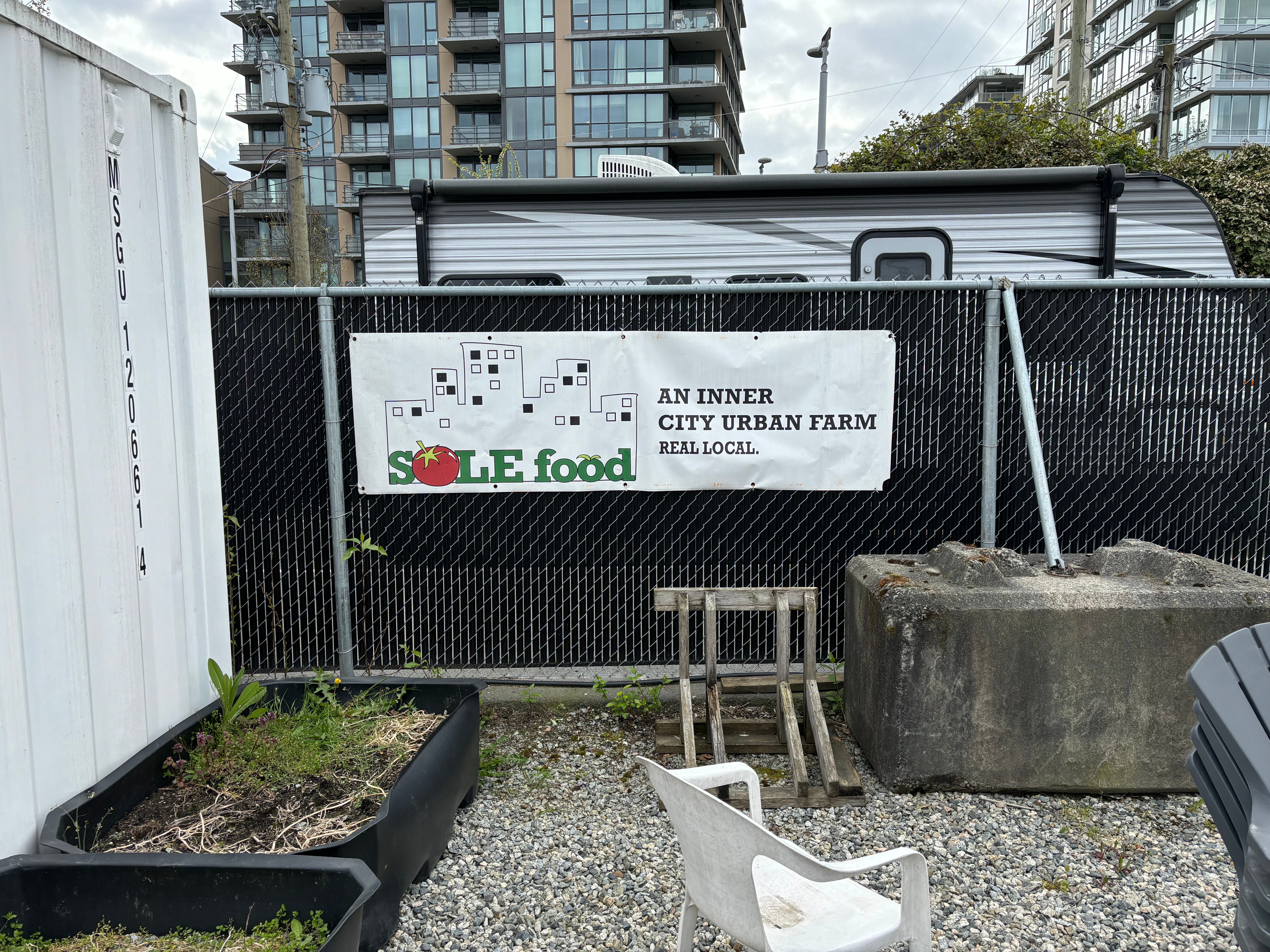
My last visit was to an inner-city farm on contaminated land adjacent to the Olympic Village — the luxury apartment complex built for athletes of the 2010 Winter Olympics and subsequently sold to Vancouver’s wealthy. I paused before entering, struck by the uncomfortable awareness that I had flown a long way to understand the value of the close-to-hand. My flight from Edinburgh had emitted more carbon than a season of organic grain farming would sequester. As a frequent-flying cosmopolitan who had gone straight from the airport to a six-course locavore tasting menu, I was precisely the demographic the Olympic Village had been built for once the athletes had gone. I wanted to be the person who supported urban farms. I was also the natural target of the property salespeople selling high-end waterfront apartments just across the road.
Sole Food Farms employs thirty vulnerable Downtown Eastside residents in production-grade agriculture on raised plastic beds. The contaminated ground beneath cannot be broken. They supply twenty restaurants, including Burdock & Co. One third of their produce goes to Downtown Eastside community services. The same greens that appear on a Michelin-starred plate feed people in shelters just blocks away. Localism, it turns out, can have a social justice spine.
***
I had arrived in Vancouver with a radius on a map. One hundred miles: simple, measurable, and appealingly concrete. What the week’s conversations produced was the recognition that the local is a set of relationships — between a chef and the farmers she has known for thirty years, between a CSA subscriber and the harvest they have partly underwritten, between a Downtown Eastside resident and the farm that employs them, feeds them, and gives them somewhere to be.
MacKinnon was right that distance is the enemy of awareness. But distance, it turned out, was the wrong measurement. The large dairy farms near Agassiz are technically local. They are nearby. But they import their feed, export their manure, and have little idea who eats what they produce. Meanwhile Burdock & Co serves wine from small producers in Italy because Carlson’s soil ethics matter more than postcodes.
Local, in the end, is not about how far the food has travelled. It is about relationships and an economy of attention.