

As I walked through Geneva airport in 2022, following my first post-Covid flight, I reflected on how this space was, supposedly, the antithesis of the local. Airports have become the ultimate symbols of placelessness, what the anthropologist Marc Augé called “non-places,” and what the urbanist Manuel Castells called the “space of flows”—a friction-free, mobile, networked world of familiar towels, duty-free cologne, and identical lines of welcome in each Marriott or Hyatt.
But there was something else going on in this airport too—something simultaneously located and global. Geneva was decidedly different from Edinburgh airport, the one I had left an hour and a half earlier. Gone were the references to thistles, tartans, single malt scotch, and the novels of Walter Scott. This was an airport decorated with the symbol of cosmopolitan wealth in the space of flows: the luxury watch. A large screen showed a beautiful multiface Breguet watch with the logo “MAKE HISTORY WITH US.” On another screen, an elegant beige cashmere-clad woman stared at me confidently, her wrist positioned to show off her Patek Philippe. “BEGIN YOUR OWN TRADITION” the advert, and by implication the woman, instructed me. Clearly some focus group had decided that advertising watches had to say something about the longue durée.
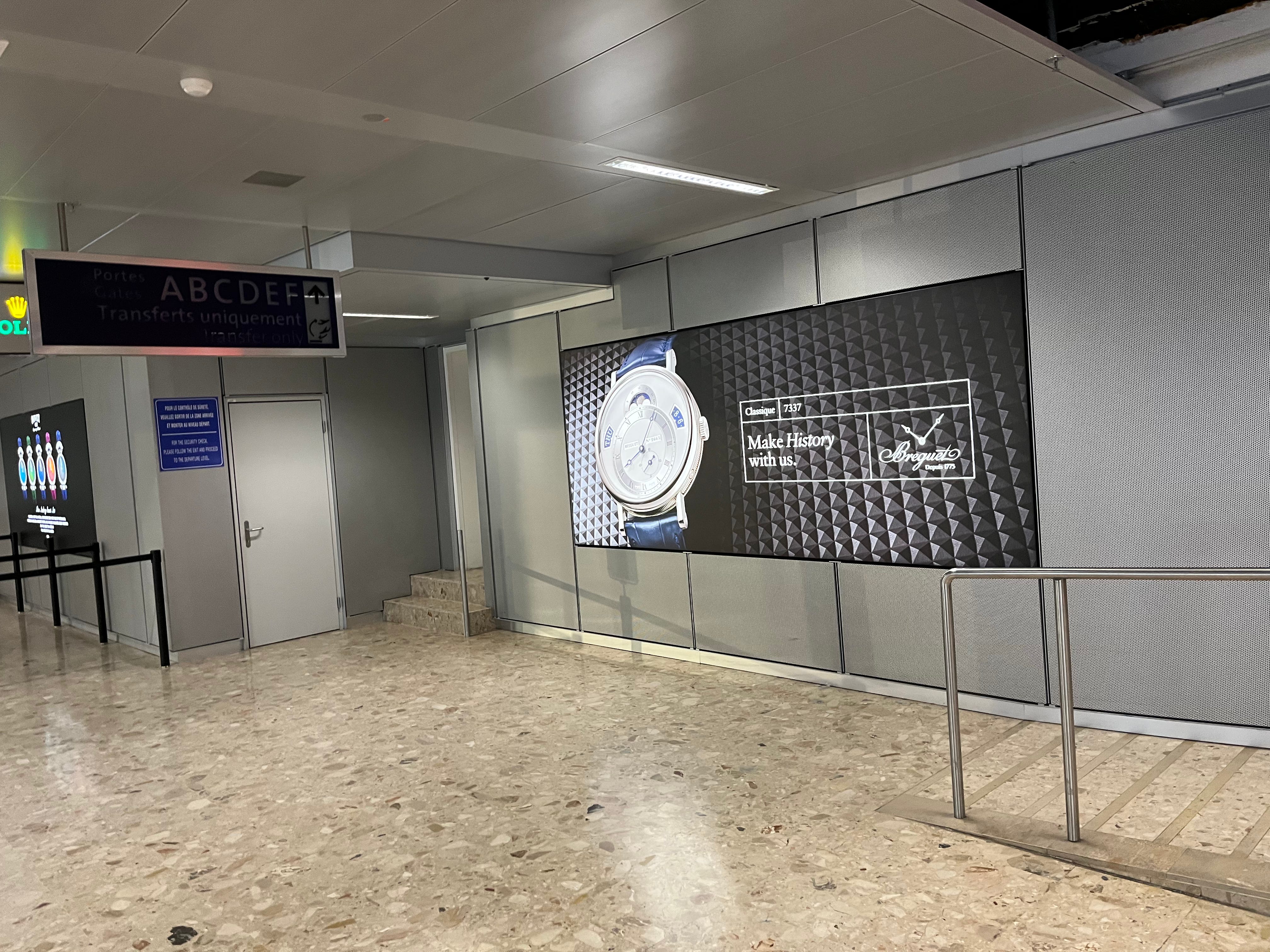
The space of flows and the space of places, places and non-places, while polar opposites in the world of social theory, are un-subtly layered in actuality. And I was travelling to one of the places where that layering began.
I was heading up into the Jura mountains, where the geographer Peter Kropotkin had once hung out with watchmakers while formulating the philosophy and practice of mutual aid. The whole thing seemed like a big intellectual joke for a geeky geographer: the father of mutual aid among the very watchmakers who were building the possibility of standardised clock time - the time that would help capitalism to conquer the world. Having seen a dramatic and sudden revival of calls for mutual aid during the pandemic lockdowns, I wanted to understand why local forms of action act as emergency first aid in the 21st century. So, I had to visit its birthplace.
The local train from Neuchâtel takes half an hour, ascending from 470 metres to 1,001. I finished a jambon and gruyère sandwich as the train headed sharp left into a tunnel. A landscape of bright white snow greeted it as it emerged. It was as if we had entered a different world.
My companion on this trip was Peter Kropotkin, who died in 1921 but who had once arrived here in search of the same thing I was. “Of all the towns of Switzerland that I know, La Chaux-de-Fonds is perhaps the least attractive,” he wrote, noting the high plateau devoid of trees where “the snow lies as deep as at Moscow, and melts and falls again as often as at St. Petersburg.” It is true that the town did not immediately strike me as beautiful. With a population of around 40,000, it is one of the highest industrial towns of its size in Europe. And yet it was here, and in adjacent Le Locle, that over 50% of all the watches in the world were made in 1900. At the same time, this small and isolated valley was the global centre of anarchism.
I left the station and headed into the town, which unfurled up a south-facing slope. This was a landscape of right angles - a grid. Such an arrangement might be familiar in North America or Ancient China, but it is highly unusual in Switzerland, where organic, winding medieval streets are the norm. Houses were built on the slope, facing south, to maximise light, each row far enough up that its higher windows looked over the roofs of the row below. This plan was not accidental. It emerged following a fire in 1794, when the town was rebuilt to facilitate a new way of making watches: the établisseur system.
It was this system that led Marx—not a man known for his brevity—to write the longest sentence in Volume One of Capital. “Formerly the individual work of a Nuremberg artificer,” it begins, “the watch has been transformed into the social product of an immense number of detail labourers, such as mainspring makers, dial makers, spiral spring makers, jewelled hole makers, ruby lever makers, hand makers, case makers, screw makers, gilders…”—and on it goes, for the better part of a page, through pivot makers and escapement makers and enamellers, all the way to the repasseur, “who fits together the whole watch and hands it over in a going state.”
What Marx did not note was that this particular division of labour brought with it a very specific urban form. The production of time was linked at the hip to the production of space. The workers in the établisseur system were, like many of us during the two years of lockdown, “working from home.” Home place and workplace were the same thing. The work involved tiny parts, steady hands, and wearable magnifying glasses. It needed good light in an age before electric lighting, which meant large and plentiful windows. And because each piece was highly specialised and spatially separated from the others, runners were needed to collect the parts and deliver them to the repasseur for assembly. This is where the grid came in.
Each worker was essentially a contractor who, in Marx’s terms, owned their own means of production. No one was working for anyone else - yet cooperation was needed for the watch to be made. It is, in many ways, a perfect model of cooperation between autonomous agents. Little surprise, then, that they did not look favourably on any kind of dictatorship—including the dictatorship of the proletariat preferred by Marx and Engels.
The end point of my walk up the gridded slope was a large white house overlooking the town. This is the Villa Jeanneret-Perret, the Maison Blanche. It was the home of Georges-Édouard Jeanneret, a watch enameller, one of the jobs on Marx’s endless list, and his wife Marie-Charlotte, a pianist. It was designed by their son Charles-Édouard, his first independent project. Born in La Chaux-de-Fonds in 1887, the family had lived at the foot of the grid-patterned slope. Now the son’s white house looked down on the grid from above. It was cleaner, more geometrical, and entirely white. It was nothing like the art nouveau houses laid out below.
In 1920, Charles-Édouard Jeanneret changed his name to Le Corbusier. This was, for want of a better term, a branding exercise, one that allowed him to escape his rural and provincial Swiss roots and become the figurehead of a movement that sought to escape the limitations of the local altogether. He became the pioneer of the “international style” - an aesthetic rooted in standardisation and rationalisation. Just as his name change extracted him from his local context, his architecture leaned on the idea of “universal design” that could be applied anywhere. This was the man who proposed demolishing the winding streets of Paris’s Marais and replacing them with a rigid grid of sixty-storey towers and who built the Indian city of Chandigarh around a rectangular grid of wide roads. To Le Corbusier, the grid was a “machine for living.” He loved straight lines. “Man walks in a straight line,” he wrote, “because he has a goal and knows where he is going.”
I had been walking in straight lines—along the snow-burdened rows and up the connecting roads until I reached the top of the grid. As I caught my breath and gazed at the white mansion built for a watch enameller and his musician wife, I wondered whether the young Le Corbusier’s life in this unusual grid had informed his desire to abstract himself into a brand and his architecture into a practice that could be applied anywhere. I wondered whether the universalism of the International Style was actually just the imposition of principles from this particular version of the local – a version designed to make it possible to craft watches – onto everywhere else.
I chuckled at the thought that the same urban form had informed both the godfather of modernist space and the prince of militant localism. The watchmaking grid of La Chaux-de-Fonds has accidentally birthed two entirely opposed worldviews – the hyper-localism of mutual aid and the globalist standardisation of high modernism.
Kropotkin, unlike Le Corbusier, left no trace here. He was not mentioned in the UNESCO building below, nor in the Musée International d’Horlogerie. Yet his short visits were foundational.
Born into the Russian aristocracy in 1842, he had served as a page to Tsar Alexander II, so he knew what hierarchical authority looked like intimately. His fieldwork as a geographer in Siberia had undermined the lessons of his aristocratic and military upbringing, with its “confidence in the necessity of commanding, ordering, scolding, punishing, and the like.” Command “works admirably in a military parade,” he wrote, “but it is worth nothing where real life is concerned.” It was in Siberia, he said, that he “was prepared to become an anarchist.”
La Chaux-de-Fonds finished the job. Watching the watchmakers run their own health insurance schemes, community gardens, and grocery stores, and reading voraciously through the dark hours when no watch work could be done, he found independent people with opinions. “Here I saw that the workers were not a mass that was being led and made subservient to the political ends of a few men,” he wrote. “Their leaders were simply their more active comrades—initiators rather than leaders.” When he came away from the mountains, “after a week’s stay with the watchmakers, my views upon socialism were settled. I was an anarchist.”
The mutual aid he saw was rooted in free association at a local scale – the kind of scale possible in small towns like La Chaux-de-Fonds and St-Imier. It was exactly this spirit of “new life starting again,” as Kropotkin put it, that blossomed during the Covid pandemic. As the virus arrived in the spring of 2020, mutual aid organisations cropped up across the UK. The more useless the national government seemed, the more activists insisted it was local responses that would really make a difference. Covid-19 Mutual Aid UK advised groups to “act really locally, for example just on your street or apartment block.” The hope was that hyperlocal relationships between neighbours might transcend the generational, political, racial, and gender divides that formerly kept people apart.
In July 2023 I took the bus from La Chaux-de-Fonds to St-Imier for the International Anti-Authoritarian Gathering, marking 150 years since the founding of the Anti-Authoritarian International in the same town. I was supposed to be on a train, but anarchists camping too close to the tracks had led to the rare cancellation of Swiss trains and a replacement bus. Anarchists and timetables, it turned out, were not easy bedfellows.
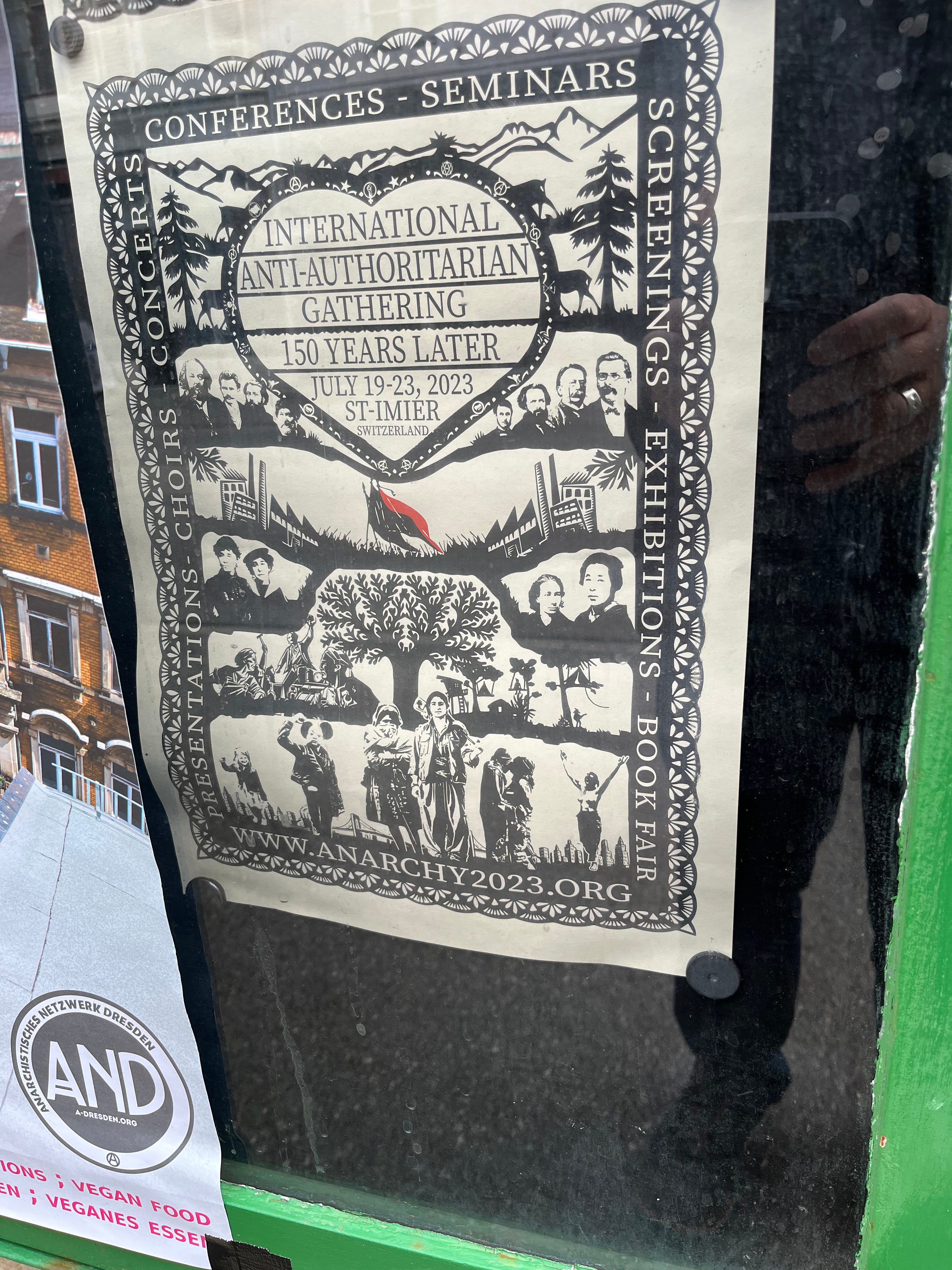
The programme offered a dizzying array of options: “relationship anarchy,” “celebrating failure,” “basics of wound treatment,” and my favourite, “anticapitalist yodelling.” I chose a workshop on combating the pipeline from transphobia to fascism. My smart-casual attire and lack of tattoos probably marked me out as a fed—or possibly just a writer.
Anarchists are widely assumed to be violent, balaclava-wearing types intent on smashing all forms of organisation. It is this caricature that has prevented many from engaging seriously with anarchist thought, which is often, explicitly, about ways of organising. What emerged before me was a masterclass in consensus building, not through a figurehead but through conscientious listening: a choreography of hand signals, remarkable tolerance of critique, and gentle correction accepted with gratitude rather than shame. The anarchists were gently and beautifully teaching each other, and listening, as they moved towards consensus. I found it strangely moving. It was an embodiment of the mutual aid Kropotkin had seen in these same valleys 150 years before.
When I emerged from a film screening and sat down for a sandwich, a group of people dressed in black with balaclavas appeared and began arguing with a woman distributing pamphlets from a table. The distribution had apparently been forbidden. The shouting grew louder, the woman looked terrified, and eventually the people in black swept up all the pamphlets and took them away. It was a sudden dark, violent cloud in an otherwise sunny, cooperative event.
As I watched the men in black carry the pamphlets away, one of the central tensions of my journey became clear. The watchmakers themselves had learned this the hard way. By 1877, machine-made American watches had gutted the market for cheap Swiss ones and half the town was out of work. The municipality opened dining rooms serving meals at cost. La Chaux-de-Fonds was now firmly locked into a global system that, through the production of standard time, its own watchmakers had been busy making. It was the beginning of the pivot to luxury: the industry that now produces the Breguet watches whose billboards had asked me to make history with them in Geneva airport.
The reach for the local, with its dreams of community and mutual aid, is freighted with the constant possibility of being undone. It is immensely fragile. It is threatened from the outside by the larger standardising forces of contemporary globalised capitalism, just as the world of the watchmakers had been in 1877. And it is threatened from the inside by the urge for purity and the silencing of difference and dissent.
The local needs work. It does not just happen.