

Moving On, Moving Out, and Moving Up?: How Spatial Mobility Became a Stand-in for Success
Why we keep confusing “mobility”
Often, when I announce myself as a scholar of mobility in a gathering of social scientists, my companions will assume that I mean I am interested in how people move up and down a socio-economic hierarchy – how they become richer or poorer, or more or less successful. While I am referring to geographical or spatial mobility, they are interpreting it as social mobility. This is not that surprising as the two ideas have long been connected both in the pages of social scientific treatises and in the popular imagination. Indeed, clues to the conceptual connection between the two can be found in the etymology of the word “mobility” in the English language. The word has roots in the archaic mobile, an abbreviated form of the Latin mobile vulgus – the disorderly and excitable crowd – what we now call the “mob”. It was opposed to the nobility. The Old French term, mobilité, referred to a state of changeability, or restlessness or fickleness. By the 15th Century, mobility was being used in English to denote the capacity for motion in a geographical sense. It was only in later centuries that some of the meaning of mobility was transplanted back into a social sense to refer to the ability to change a social or economic situation. In its original meaning of the “mob”, however, it was always coded in social ways.
Frontier Dreams.
It was not until the early 20th Century that “social mobility” became a reasonably well-known concept in academic circles, and it had varied connections to the longer standing notion of mobility in space. In 1906, for instance, the historian Frederick Jackson Turner in a summary of his frontier thesis in the American Historical Review wrote that:
The ideal of the West was its emphasis upon the worth and possibilities of the common man, its belief in the right of every man to rise to the full measure of his own nature, under conditions of social mobility. Western democracy was no theorist’s dream. It came. stark and strong and full of life, from the American forest.[1]
Turner’s thesis was that Europeans arrived in the American colonies and moved west across the Appalachians and then the Mississippi, and in doing so, stopped being Europeans and became Americans. They needed to move west to free themselves of the shackles of Europe which was portrayed as ossified and socially immobile. Once the settler colonies were established on the East coast, then these too became signifiers of suffocating hierarchies that necessitated further movement west by the pioneers who escaped their social shackles and became properly American. Geographical mobility was linked to what Turner called “the right of every man to rise to the full measure of his own nature” – in other words, social mobility.
The Invention of Social Mobility
While Frederick Jackson Turner used the term “social mobility” as early as 1906 it was not until 1927 that the term was officially entered into the lexicon of social science by the Russian-born American sociologist Pitirim Sorokin.Sorokin used the term social mobility to refer to the “shifting of individuals within social space”[2] but, unlike Turner, he was very careful to analytically differentiate movement in social space from what he called geometrical space, arguing that people very close to each other could be socially miles apart and vice versa.
The concept of social mobility followed, for Sorokin, from the concepts of social location and social distance. All of these are metaphors that have their roots in conceptions of absolute space and lead, almost by necessity, to the possibility of social mobility – the ability to move in social space across social distance from one social location to another. Despite Sorokin’s careful insistence that he was not talking about geometrical space, his concepts were, nevertheless, spatial in nature. Social mobility, Sorokin argued, could refer to transitions between social groups horizontally (such as moving from a Methodist church to a Baptist church) and, more importantly, vertically in a hierarchy, by becoming more affluent, or more educated.
Chicago Rings – Moving Out and Moving Up
Sorokin did not have Turner in mind when he sought to separate social mobility from geometrical mobility, rather it was the emerging work of the Chicago School of Sociology where Robert Park, Ernest Burgess and others had been developing what they called an ecological approach to urban life that firmly linked movement in social space to movement in geographical or geometrical space. Their work is most famously represented by the concentric ring model of the city, based on their explorations of Chicago.
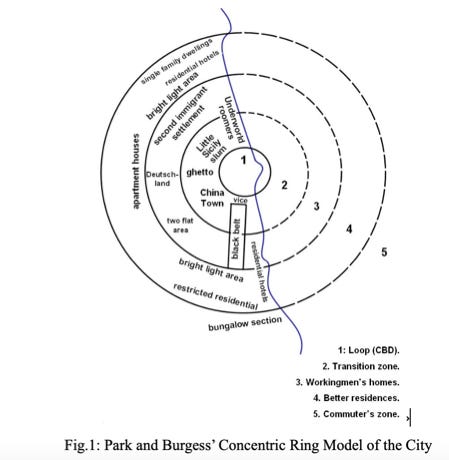
The concentric rings are a spatial representation of the outcome of a series of spatial processes that Park and colleagues referred to, following the science of ecology, as succession. Immigrants would arrive in the central zone in transitionand as they became more successful, and more integrated, they would move out to the suburbs. As they moved up in the social world they moved out in the spatial one. The link could hardly have been made clearer. Park wrote, in his essay The Concept of Position in Sociology that “The point is that change of occupation, personal success or failure—changes of economic and social status, in short—tend to be registered in changes of location”, unlike in the work of Sorokin, social and spatial mobility were joined at the hip.
In the work of Park in particular, mobility as both social and spatial was remarkably thoroughly theorised well before anyone formulated a new mobility paradigm. “Mobility” Park argued, “measures social change and social disorganization, because social change almost always involves some incidental change of position in space, and all social change, even that which we describe as progress, involves some social disorganization”.[3] The idea that upward social mobility in the city could be equated to outward geographical mobility towards the suburbs of the commuter zone rapidly became the formular of moving up and moving out. But geographical mobility was given meanings other than success in the urban ecology framework. Park’s colleague, Ernest Burgess, argued that areas of the city marked by constant mobility were where you would find “juvenile delinquency, boy’s gangs, crime, poverty, wife desertion, divorce, abandoned infants, vice”.[4] Spatial mobility has been associated with marginality and disorganization as much as it has with success and aspiration. It is an activity of the vagabonds as much as it is of the citizens.
Sorokin, writing just two years after Park and Burgess, pitted his conceptualization of social mobility against their ecological approach. Sorokin criticized the Chicago approach as being of limited value as if failed to account for all kinds of social change that could not easily be mapped on to geographical change.
In a diagram of forms of social mobility, “territorial mobility” is listed as one amongst many forms of “horizontal” social mobility – equivalent to changing political party or occupation without any noticeable change in the social hierarchy. It is notably disconnected from either ascending or descending vertical social mobility.
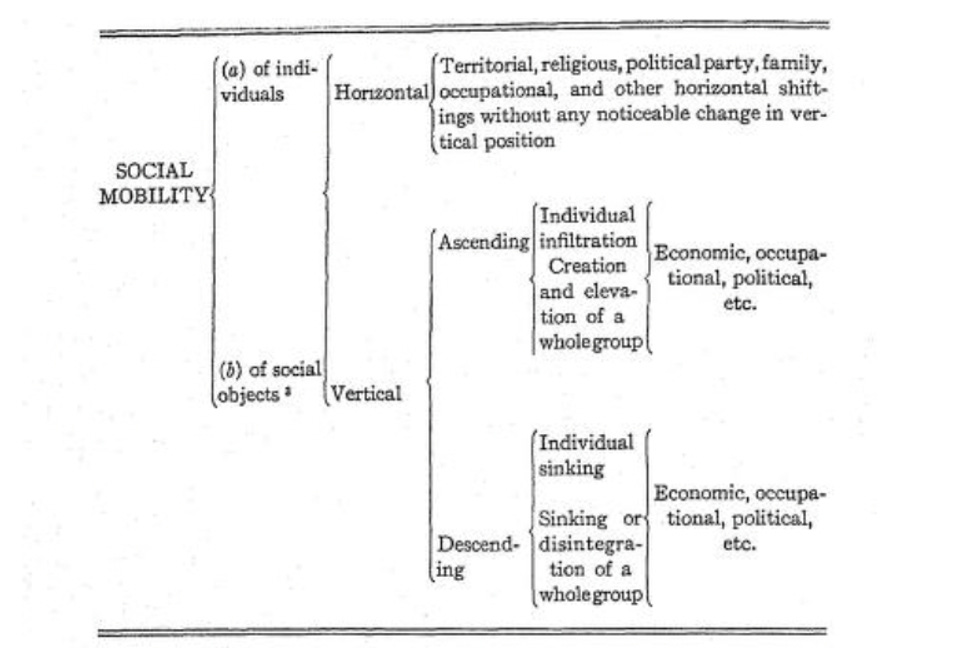
The clearest, and most prevalent, way to account for connections between spatial and social mobility is to map one on to the other as both Turner and the Chicago sociologists have done from their very different perspectives. “Moving out” is seen as evidence of “moving up” whether in the city or across a colonized continent. While Sorokin’s conceptualization of social mobility deliberately split the spatial from the social, the logic that connects then became most clearly seen in classic theorisations of migration to which I now turn.
Push, Pull, and the Black Box of Movement.
The dominant way of thinking about migration is either explicitly or implicitly through the logic of push and pull factors which see migrants as actors seeking to maximise outcomes, most often stated in terms of economic success. This approach to migration has its origins in the work of E.G. Ravenstein’s “laws of migration” developed in two papers in 1885 and 1889 – several decades before social mobility entered scholarly discourse. Ravenstein was drawing on a report by the registrar-general on Britain’s 1871 census who noted how improved transport and communication has led to the movement of labourers from “spots where they were not wanted to fields where their labour is in demand”.[5]
Ravenstein’s laws of migration focused on the observation that the primary cause of migration was the need for labour in larger urban centres. People in rural areas would move to the nearby market towns and gradually, through a kind of cascade of migration currents, feel the attraction of larger and more distant centres of opportunity. Thus, a larger flow of rural to urban migration would emerge as people sought to improve their circumstances. Law number seven stated: “Bad or oppressive laws, heavy taxation, an unattractive climate, uncongenial social surroundings, and even compulsion (slave trade, transportation), all have produced and are still producing currents of migration, but none of these currents can compare in volume with that which arises from the desire inherent in most men to ‘better’ themselves in material respects”.[6] The connection between moving in space and seeking a better life could not be more clear.
It was not until 1966 that Everett Lee used Ravenstein’s work to formally develop a Push and Pull Theory of migration . Lee’s theory of migration focused on four drivers or obstacles to migration – the origin point (push factors), the destination (pull factors), obstacles along the way (primarily distance), and the personalities of those considering a move. The first three are represented in a diagram.
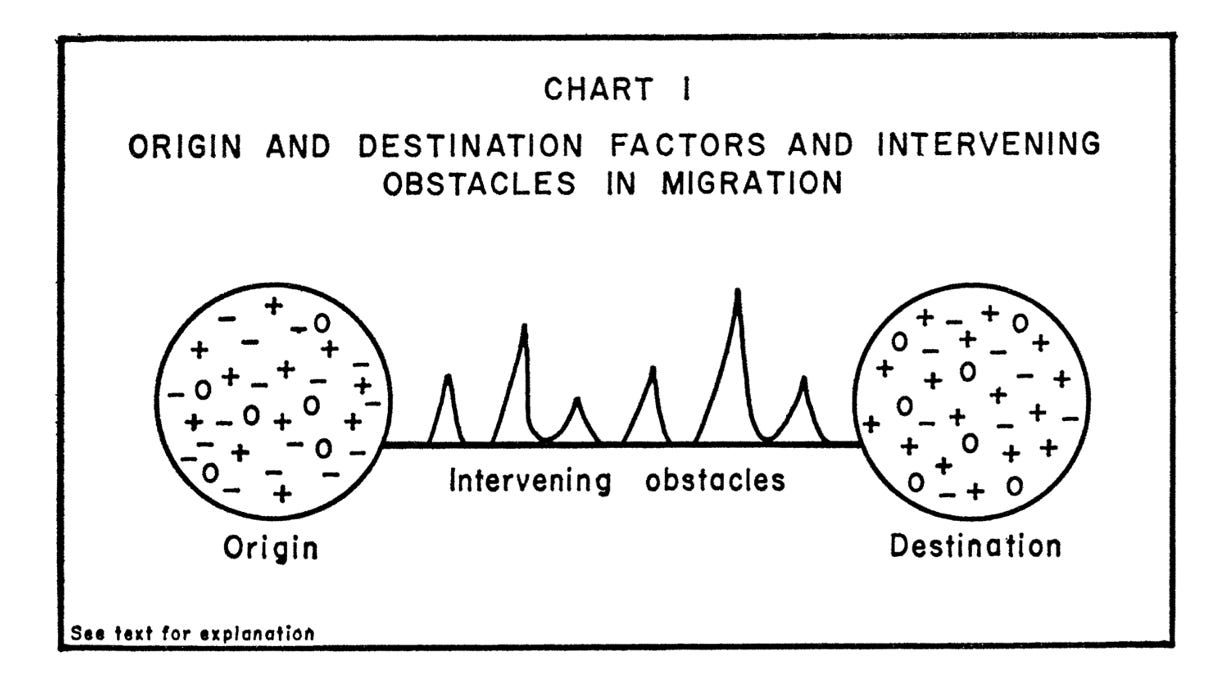
He was careful to note that the +ve and -ve signs in the origin point and destination were not necessarily actual factors but, rather, perceptions of costs and benefits that a migrant might factor into a decision to move of stay. What is notable about this classic formulation is that pays almost no attention to the practice of moving itself. It is effectively “black boxed”. There are, however, other ways of more directly linking the practice of mobility to positions in a kinetic hierarchy.
Kinetic Hierarchies – Status in Motion
While the Chicago School of Sociology equated moving out from the inner city to the suburbs as simultaneously moving up the social order, scholars of international migration have stereotypically seen the causes of migration as connected to the search for a better life. Both formulations focus more on the places left and arrived at than on the act of moving itself. Mobility itself (how, when, how often, how fast etc.) is also a social differentiator, creating “kinetic hierarchies”. How people move is as important as where they leave and where they arrive. Clues to this are to be found in earlier work. In Everett Lee’s foundational theory of migration, for instance, he notes how people who have migrated once are likely to migrate again, how there is a general sense of more developed countries, and regions, being more mobile and less stagnant than less developed ones, and how professional and managerial classes of employee are likely to be highly mobile in ways that are connected to their career advancement. Recent work on mobilities has made the connection between the act of moving and social position explicit and in ways that are not tied to older theorisations of social mobility. While classic push-pull migration theory focused on points of departure, points of arrival, obstacles to moving, and the influence of personality, mobility theory focusses more intently on the actual act of moving. Thomas Birtchnell and Javier Caletrio, for instance, describe what they call “elite mobilities” that “inform cultures of luxury, success and ‘the good life’ and enforce a self-stylization of global elitism founded on hypermobility, meritocracy and entrepreneurial heroism”.[7] This is the world of first-class tickets, superyachts, private jets, fast lanes in airports, and other accouterments of “high net-worth individuals”. In many ways it is modes and experiences of mobility that define what it is to be elite, and elite mobilities become the organizing principle that defines mobilities for everyone else.
Infrastructures are designed first with the agendas of the few in view before the social considerations of the rest are addressed. The few set a certain tempo to the movement of the many through space and to their bodily conduct; elite mobilities are instrumental in the setting of speed limits, the location of airports, the provision of urban toll-roads, the comportment and apparel of travel and so on. [8]
To be socially mobile is not so much to move from one place to another but to move in different ways – to inhabit a different mobile world. And this mobile world is the one that sets the terms for others, in the middle or at the bottom of kinetic hierarchies.
Locals and Cosmopolitans
One of the most significant binaries that has emerged in the current political landscape is that between locals and cosmopolitans, or globalists. The cosmopolitan globalist has become the bogeyman of the new authoritarian right in ways that echo the cultural norms of fascism. In Nazi Germany, for instance, Jews, gypsy-travellers, and gay people were associated with both the city and, metaphorically, the desert – all spaces associated with shallow horizontality and a lack of roots. Aryans, on the other hand, were rooted in the deep fertile soils of the Black Forest. The binary of local ruralism and placeless urbanity is being played out again in contemporary US politics where “globalists” are frequently invoked as the metropolitan and cosmopolitan enemy within.
It is certainly the case that a social elite has been constructed around spatial mobility. It is exactly this move from a relatively local and relatively rural world to a more globally connected urban one that has been at the centre of theorisations of migration since the early work of Ravenstein. In a recent reflection on the opening up of free mobility in the European Union, Adrian Favell and Ettore Recchi reflected on the role of people they call “Eurostars” or “pioneers” in the process of affirming a European project centered on mobility. Talented, ambitious people, they argue, have long been associated with high rates of spatial mobility, moving out of “local worlds they live in, or order to move up”. This, they argue, “was a key dynamic of industrialization and the formation of the nation-state in the modern world”.[9] They describe these acts of spatial mobility as part of an “escalator effect” “like stepping on a moving escalator that sweeps you along and upwards faster than your peers”.[10] While general rates of both spatial and social mobility might not have increased as markedly as might be expected – these Eurostars, a mobile and cosmopolitan elite, have an influence on the EU project which is far greater than their numbers.
Locals and cosmopolitans have been contrasted in other ways. Literary scholar, Terry Eagleton, once wrote that “the rich have mobility and the poor have locality … the rich are global and the poor are local”[11]. Sociologist Manuel Castells wrote “elites are cosmopolitan, people are local”.[12] I presume Eagleton and Castells are well travelled. Even if they only travel as much as I do – they are well travelled. They inhabit the skin of the cosmopolitan elite in some sense. I do this too. When I do it, I encounter (for instance) taxi drivers from Ethiopia and Somalia. When I am in my hotel room I cannot help but notice that the people cleaning the room for me are invariably eastern European or/and from Southeast Asia. They appear to speak multiple languages and have relatives in London. The poor/people seem to be mobile and far more cosmopolitan than us – the kinetic elite. The English-speaking academics and business people who flit around the world rarely speak the number of languages spoken by their supposedly immobile and non-cosmopolitan underlings who drive them places and clean their rooms. They may do more miles but in many ways they travel less. It is the different ways in which they move that need to be attended to.
I presume that Eagleton and Castells rarely find themselves in agreement with Donald Trump but, in this case, their perspectives are shared. It is exactly the “liberal cosmopolitan elite” who have become the enemy of the new right. Citizens of nowhere. This seems to be a long way from the original meaning of mobility as the fickle, restless, “mob”. The mobile vulgus. But there are, of course, connections as the other enemy of the new right are the vagabonds – the migrant – and equally cosmopolitan – poor seeking a better life who have long been the exterior outsiders whose mobility threatens the rooted inside. It is the migrant poor who are given the label “economic migrant” as though that were a term of abuse. Just as mobility is the defining characteristic of elites that Eagleton, Castells and the authoritarian right identify, so it is the geographical reality of Hardt and Negri’s multitude – the new proletariat – the 21st century mobile vulgus “Whether driven by officially sanctioned motives, such as fleeing war or persecution, or for reasons delegitimated by the authorities, such as simply seeking adventure” they write, “migrants affirm the freedom of mobility, which can serve as the basis for all other freedoms”.[13] The two enemies of the new right – the cosmopolitan elite “globalists"“, and the economic migrants and refugees do not share much, but they are characterised by their mobility, taking their place along a kinetic hierarchy and threatening, in different ways, those who are invested in sedentarist ways of looking at the world.
Further Reading
Burgess, E. (1925). The Growth of the City: An Introduction to a Research Project. In R. Park & E. Burgess (Eds.), The City: Suggestions for Investigation of Human Behavior in the Urban Environment (pp. 47-62). University of Chicago Press.
Favell, A., & Recchi, E. (2011). Social mobility and spatial mobility. In V. Guiraudon & A. Favell (Eds.), Sociology of the European Union (pp. 50-75). Palgrave.
Lee, E. S. (1966). A Theory of Migration. Demography, 3(1), 47-57. https://doi.org/10.2307/2060063
Sorokin, P. A. (1927). Social mobility. Harper & Brothers.
Turner, F. J. (1906). The Colonization of the West, 1820-1830. The American Historical Review, 11(2), 303-327. https://doi.org/10.2307/1834646
[1] Turner, F. J. (1906). The Colonization of the West, 1820-1830. The American Historical Review, 11(2), 303-327. https://doi.org/10.2307/1834646
[2] Sorokin, P. A. (1927). Social mobility. Harper & Brothers.
[3] Park, R. E. (1926). The Concept of Position in Sociology. Papers and Proceedings of the American Sociological Society, 20, 1-14.
[4] Burgess, E. (1925). The Growth of the City: An Introduction to a Research Project. In R. Park & E. Burgess (Eds.), The City: Suggestions for Investigation of Human Behavior in the Urban Environment (pp. 47-62). University of Chicago Press.
[5] Ravenstein, E. G. (1885). The Laws of Migration. Journal of the Statistical Society of London, 48(2), 167-235. https://doi.org/10.2307/2979181
[6] Ravenstein, E. G. (1889). The Laws of Migration. Journal of the Royal Statistical Society, 52(2), 241-301. https://doi.org/https://doi.org/10.1111/j.2397-2335.1889.tb00043.x
[7] Birtchnell, T., & Caletrío, J. (2014). Elite mobilities [text]. Routledge.
[8] Ibid.
[9] Favell, A., & Recchi, E. (2011). Social mobility and spatial mobility. In V. Guiraudon & A. Favell (Eds.), Sociology of the European Union(pp. 50-75). Palgrave.
[10] Ibid.
[11] Eagleton, T. (2003). After theory. Basic Books.
[12] Castells, M. (2000). The rise of the network society (2nd ed. ed.). Blackwell.
[13] Hardt, M., & Negri, A. (2019). Empire, Twenty Years On. New Left Review, 120, 67-92.
Very interesting article. As a recent immigrant myself (I have moved between European countries) I'm always a bit shocked when people in my adopted country explain that they don't mean for the implications of their voting for right-wing political candidates to affect people like me. I point out that the policy changes are very real for me. ALL immigrants are affected.
Fascinating article. Many thanks for this and previous posts Tim. The idea of “moving out and moving up” will be very helpful to my local/global history investigation of
Saltaire. As well as helping me make sense of current trends it also helps me make sense of my own mobility. A working class lad from south London who has finished up retired in Extremadura, Spain, via Bradford, Yorkshire. Now working on developing a new sense of place with the benefit of your posts. Thanks.