

If you enter the search terms satoyama and Kyoto into YouTube as I had done before my visits to Kyoto, one of the first videos you will find is a grainy rendition of a David Attenborough documentary made in 2004 called Satoyama: Japan’s Secret Water Garden. The documentary follows a fisherman and several varieties of fish through, in, and around the town of Harie-no-Sato on the western shore of Lake Biwa. During my second visit to Kyoto to explore satoyama I took a train out of Kyoto and up the edge of the lake to the Shin-Asahi station. From there it was a short walk to the Harie Community Centre. I had booked a tour. This was not straightforward. The people leading the tour did not appear to want to be easily found on the internet – but it was clear that you were not supposed to go unguided.
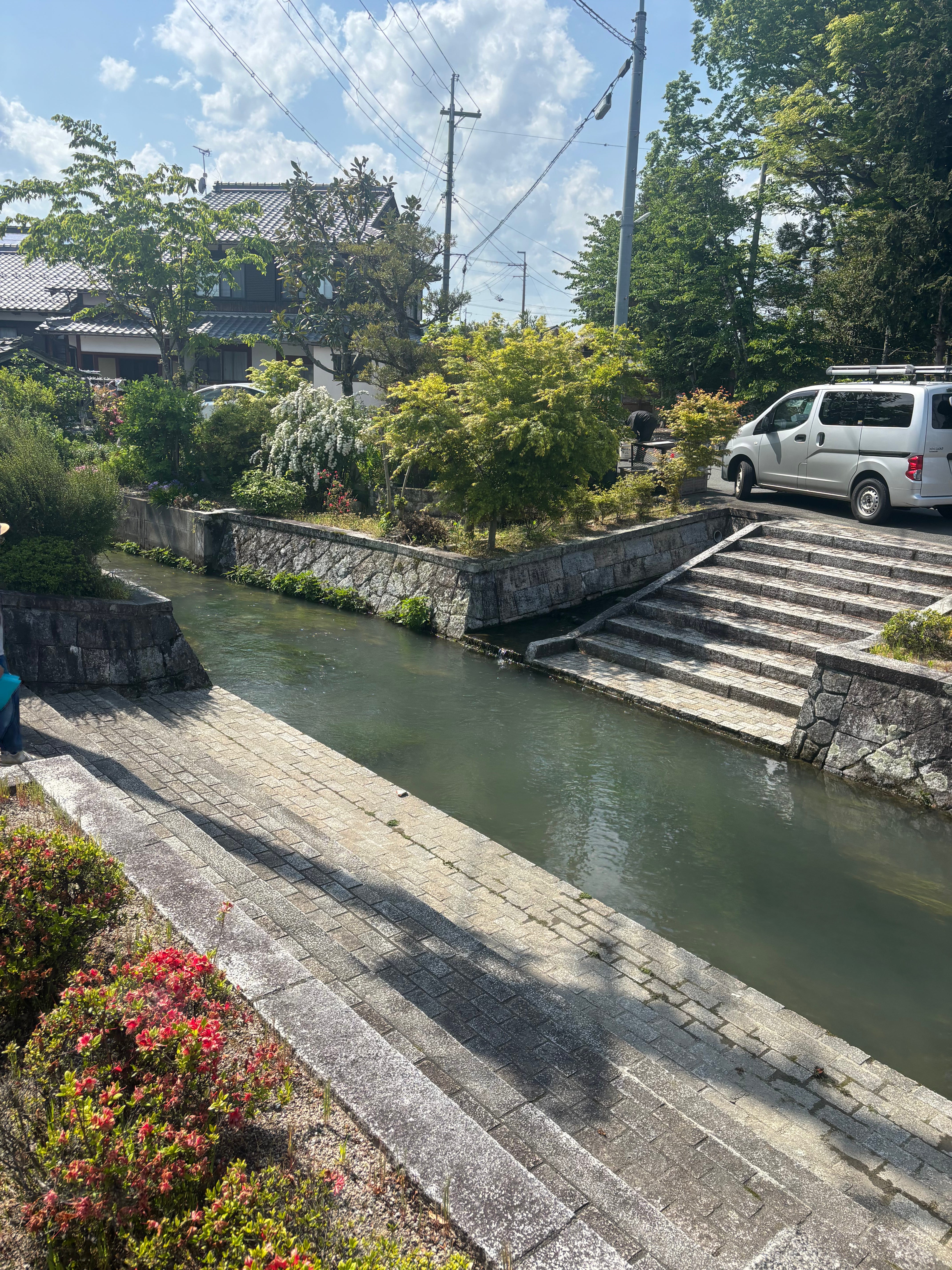
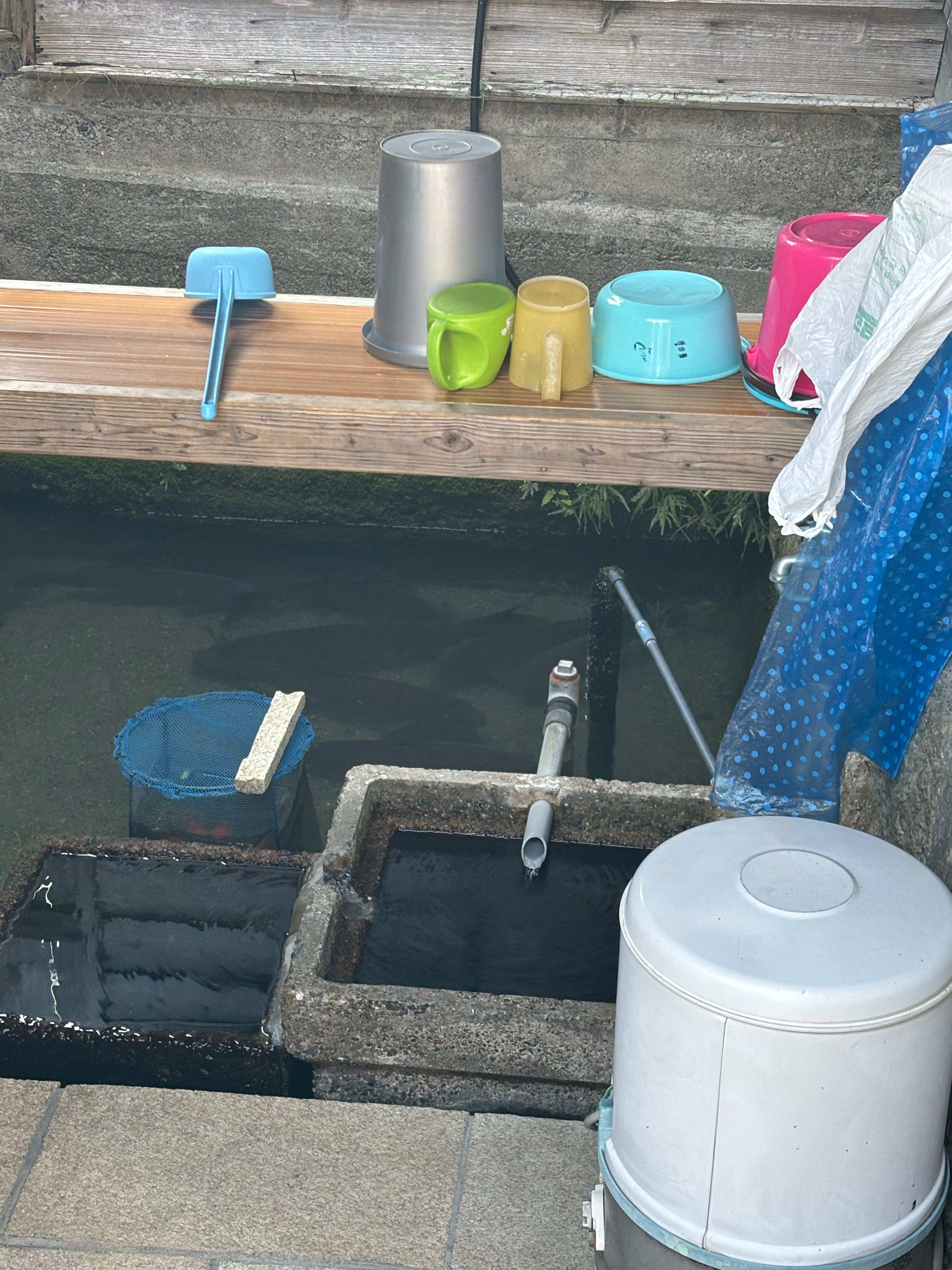
As I entered Harie it quickly became clear that water was a kind of ordering principle. The sound of streams became a constant. They appeared alongside the road into the village, and between the houses clad in cedar boards charred and blackened for preservation. I arrived at the small booth at the community centre and paid my 1000-yen fee. We were joined by seven other visitors – from Japan, Korea, and a couple from Germany who had arrived on a motorbike. Our guide, Akira, asked us how we had found out about Harie as though we had discovered a secret. We had all seen the Attenborough film. This, he said, was true of about 60% of visitors who came because of the documentary. Before Covid, the numbers had been much higher but had dropped off since the world opened up again. I asked if this was a good or a bad thing. He left no doubt that it was good. At the very least, it makes his job easier and more personal. He led us through the village as though through a plumbing system – organizing the itinerary and stops besides springs, channels, ponds, kitchens, carp, vegetable-washing stations, and drains, with the ever-present Lake Biwa beyond us, and Kyoto and Osaka downstream. The water moved constantly. It passed through hands and houses and ponds, through the mouths and bellies of impressively large grey carp, before returning to a more-than-human circulation. On several occasions we stopped beside domestic water systems in small sheds outside the house and beside the road. “Anyone can dig for a spring here” he said “there are no rules.” In each domestic system there were two pools of water inside a large one. The first, where the spout provided a constant stream of water, was for drinking water, the next, which the drinking water overflowed into, was for washing and storing vegetables. Then this water spilled into the larger pool which was also a home for carp. The carp were there to clean the water of food from the dishes before it flowed out and joined one of the many streams that flowed between, around, and sometimes through, the houses. The carp were filtering devices. Groundwater was lifted into daily life, used, shared, and then returned “in as natural a state as possible.”
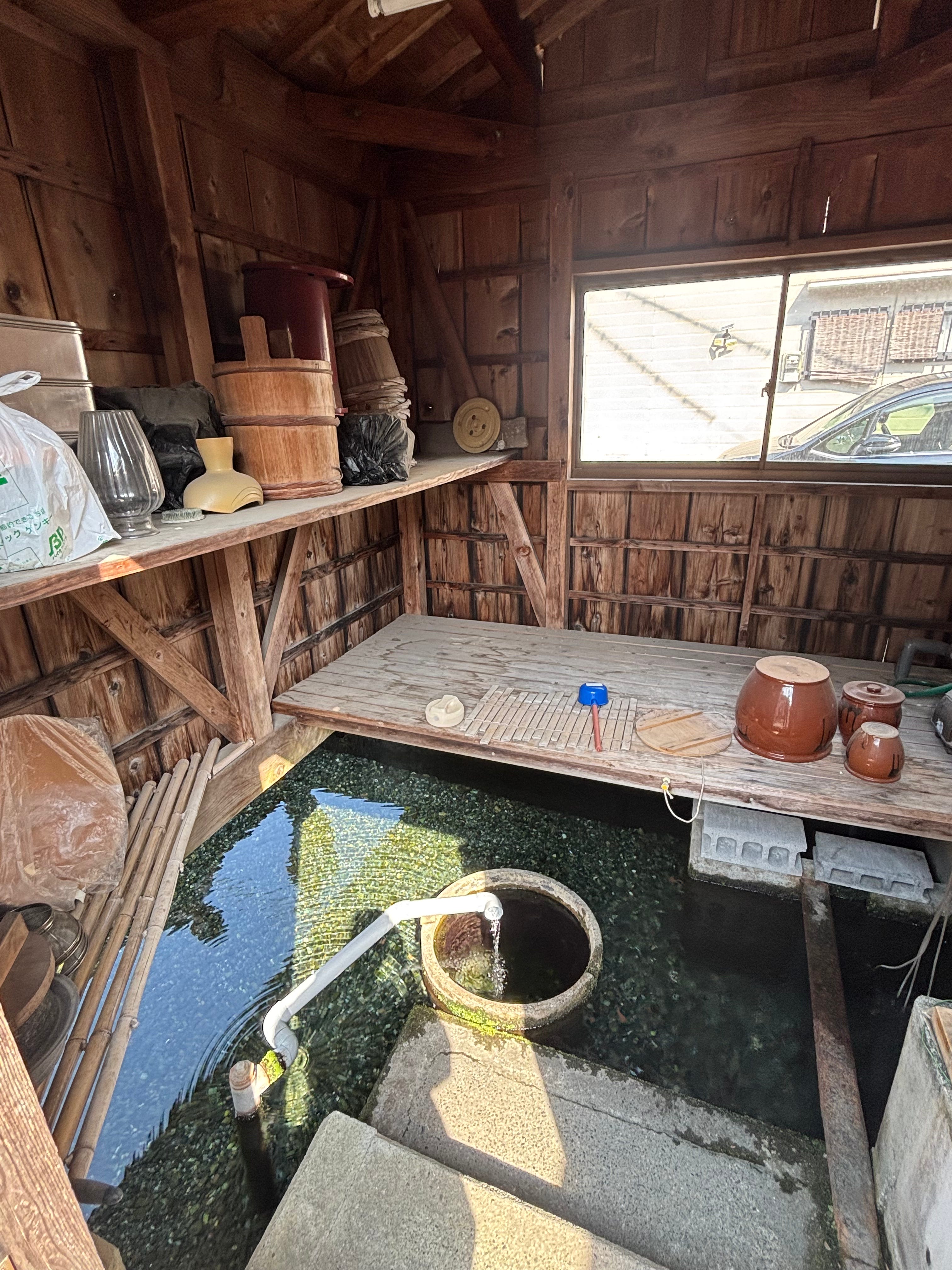
We were being shown the kabata system – household spring-water kitchens arranged around a culture of use and reuse. As we moved from one node in the system to another we were introduced to a set of small, repeated disciplines. Do not put curry roux into the water. Be careful with oil. Use detergents differently now that people know their environmental impact. Leave soil in the riverbed so aquatic plants can grow rather than sealing everything in concrete. Test the drinking water once a year and only tell visitors to drink from places that have been tested. We were each given a small paper cup and invited to taste the water at three different springs. We would place our cup under the spout where the water ran clear and cold. Akira asked visitors, as he often did at these spot, whether they could taste the difference between the springs. Generally , he said, half or more of visitors thought they could. Its “condition” or “balance” was different. I am not sure what I tasted — freshness, certainly — but I understood why he asked the question. The point was to make water perceptible again – something worth paying attention to rather than simply taking it for granted. Most of us encounter water as pressure, billing, infrastructure, or commodity – something that appears when summoned and vanishes down a hole. In Harie, Akira was telling us, water had texture, taste, direction, and social life. It was at the heart of a set of obligations running through kitchens and gardens and streams. Our final tasting was at two taps – one from a spring and one municipal (standard tap water was used for baths and laundry). Here, I could definitely tell the difference that the addition of chlorine makes.
I asked how community life was organized around the water. As it turned out, none of this required a manifesto. Akira said they did not really gather as a village to discuss the water in any formal way. They met for board elections or the fire brigade, but not especially for the water. There was, instead, a kind of tacit agreement. There would be people after them in the system – both in the village and then in Kyoto and Osaka, so the water had to be valued. Everyone in the village shared it, and so did the other living things.
The scale of this local water culture was at once intimate and regional. Akira showed us a map he carried in a folder and pointed east towards Lake Biwa, the largest lake in Japan, and reminded us that what happened here did not stay here. The used water flowed into wider systems that connected Shiga to Kyoto and Osaka. People in Shiga, he suggested, had historically been conscious of the water that entered the lake. The local, in this case, was a point of responsibility inside a connected world. Harie’s kabata system made locality by insisting that daily acts — washing vegetables, disposing of oil, feeding carp, leaving soil for water plants — mattered beyond the threshold of a single house. Here, proximity meant knowing that elsewhere began in the kitchen. The place was permeable.
This was also why it had been difficult to arrange this tour. ““Imagine if strangers from all over the world just came on their own to look at your home kitchen” Akira asked, “how would that feel?” The discomfort was obvious. The tours existed partly to prevent that intrusion – to make the village legible without turning private domestic life into an open exhibit. “They don’t do any commercial marketing” he said. You had to do the work of searching to find it. They sometimes appeared in magazines when a publisher happened to join a tour, but television variety shows were generally refused. This, too, was a lesson in locality. The same water culture that attracted visitors depended on restraint, privacy, and neighbourly trust. To make the local visible was always to risk damaging the very relations that made it local in the first place.
Beyond the waterways, the village opened into the wider world. We were shown a small textile mill where a kind of cotton crepe fabric - Takashima chijimi – was made. It benefitted from the humid atmosphere of the village, Akira told us. He mentioned the young people leaving Harie, like other rural villages in Japan. We stopped at local fish shop where an ex-teacher sold fish from Lake Biwa – including one produced by covering it in a rice slush and allowing it to ferment till it tasted like cheese. I had tasted a similar product in Norway. Never again. Food appeared here as another way water became culture as the village was connected to the lake. These fragments mattered because satoyama, and its watery cousin, satoumi, are a working mosaic of houses, fields, forests, water, food, craft, and labour, contingently held together by habit and attention. In Harie, the local was a more-than-human local. It was being negotiated through tours, tests, informal rules and tastes, and the knowledge that water shared by humans is also shared by carp, plants, and unseen downstream lives.