

Last month I spent some time in the area around Kyoto, Japan. I was there to gather material for my book about the local, currently titled ‘Here: A Global Search for the Local’. I was drawn to Japan for several reasons. I have been twice before, both times to Tokyo. There is something about arriving in Japan as a resident of a Global North liberal democracy (at the time of writing) that is particularly jarring. When arriving in Japan, it is clear that, broadly speaking, I am arriving in a developed part of the capitalist world. Much is familiar and comfortable thanks to post-World War Two globalization processes. I could, if I so chose, visit a McDonalds, or Starbucks. This is what makes the differences so startling. The aesthetics of posters in the airport and in public transit spaces, for instance, appear to be from a different planet – crowded with text and anime-like images. The representation of women is particularly weird, emphasizing a kind of disturbingly sexualized cuteness associated with young girls (shojo). The sound and intonation of the language in hospitality contexts also signifies a different world – one in which I am constantly greeted and bowed to. And even if I went to McDonalds, I would be faced with the choice of Shaka Shaka fries (fries with wasabi), a salt lychee shake and Gohan Teriyaki set. There would be a collection of elderly men whiling away their time reading papers and eating very slowly, taking advantage of the relatively cheap food. Clearly there are other places I could go to prove to myself that globalization does not produce uniform homogeneity – but it is the combination of recognizable familiarity and otherworldly strangeness that I find so interesting.
The real reason for my visit to Kyoto on this occasion, though, was to explore the world of Satoyama. I had first become conscious of the word Satoyama while watching one of an endless series of cooking related programs on television during covid lockdowns. In a gladiatorial contest of international superchefs called The Final Table, one of the chefs was the Tokyo-based double Michelin star chef Yoshihiro Narisawa, who introduced his cuisine as “innovative satoyama cuisine” based entirely on farmed and foraged local ingredients. It was more than just an emphasis on any old local, however. It was the use of local ingredients from a specific kind of landscape - one where the mountains with their forests meet the farmlands and paddy fields. His recipes include “soil soup” which is not made from some pretend soil, as is common in elevated dining establishments, but from actual soil with its rich umami tasting brew of microorganisms. His dishes often have the appearance of mini landscapes including twigs and bark foraged from satoyama forests. I would have loved to have started by journey into satoyama with a visit to his restaurant. Sadly, a combination of the £400 tasting menu price combined with the policy of not admitting single diners, made this impossible.
As it turned out, I had already encountered the term while reading Anna Tsing’s wonderful book The Mushroom at the End of the World: On the Possibility of Life in Capitalist Ruins.[1]In that book, Tsing traced the web of places that are connected by the growing, picking, trading, gifting, and eating of the matsutake mushroom – a mushroom that is highly prized in Japan. One of the sites her journeys took her to was a forest outside of Kyoto where scientists and locals were using the forest in such a way that the growth of red pine was encouraged. Red pine is the favoured companion of the Matsutake – a mushroom that cannot be cultivated so has to be encouraged. Red pine would only grow if the forest was regularly disturbed in the way that forests in Japan have traditionally been disturbed by small scale landowners who would use them for timber. Tsing referred to this traditional way of disturbing the forest as “satoyama”.
Satoyama literally means village (sato) mountain (yama). It refers to a specific kind of landscape whre humans and “nature” co-exist at the foot of mountains – often in the area between the mountains and the sea. The landscape includes secondary or disturbed forests, rice paddies, small villages or towns and some arable land. Traditionally it was in this landscape that locals would use the forest for firewood, charcoal production, thatch for the roofs of traditional houses, and mulch for farming. Advocates of satoyama insist that the use of local knowledge and techniques meant that humans existed in harmony with nature rather than dominating it, and that human interventions increased, rather than threatened, biodiversity. It is almost the opposite of the currently popular practice of “rewilding” which advocates for a (admittedly managed) return to wilderness. It was human interference, after all, that led to Anna Tsing’s matsutake mushrooms. It seemed to me that an exploration of satoyama would be a perfect episode for my book – a set of local knowledges and practices connected to a particular landscape in a country that, to me, already seemed otherworldly.
Traditional satoyama practices and knowledge, as well as the landscapes that resulted from them, began to disappear after World War Two with the rise of the use of fossil fuels for domestic heating and cooking. This meant that the areas of forest attached to village settlements, and often to individual properties, were no-longer needed for charcoal production or for other uses of wood. The forests stopped being disrupted by humans and many became dense stands of cedar and cypress that kept out the light from the understory. The red pine associated with matsutake mushrooms no longer had periodic moments of space and light to grown. The urushi tree that produced the lacquer used to make traditional Japanese lacquerware was crowded out and abandoned. Given that it was the late 1940s when this transformation happened it is little surprise that few people in Japan in the present day can remember how satoyama culture operated. I was told, on a visit to Ryukoku University’s satoyama forest, that only a few people over 80 can recall the traditional satoyama practice. People are, effectively, beginning over in re-discovering satoyama. During my visit to the forest, managed by the Research Center for Satoyama Studies, I saw areas of the forests where trees had been cleared and red pines were emerging, stacks of logs carefully placed and inoculated with shitake mushrooms, beehives designed to encourage the native exotic honeybee and protect them from the invasive European honey bee. Traditional uses of forest leaves for mulch production were being taught.
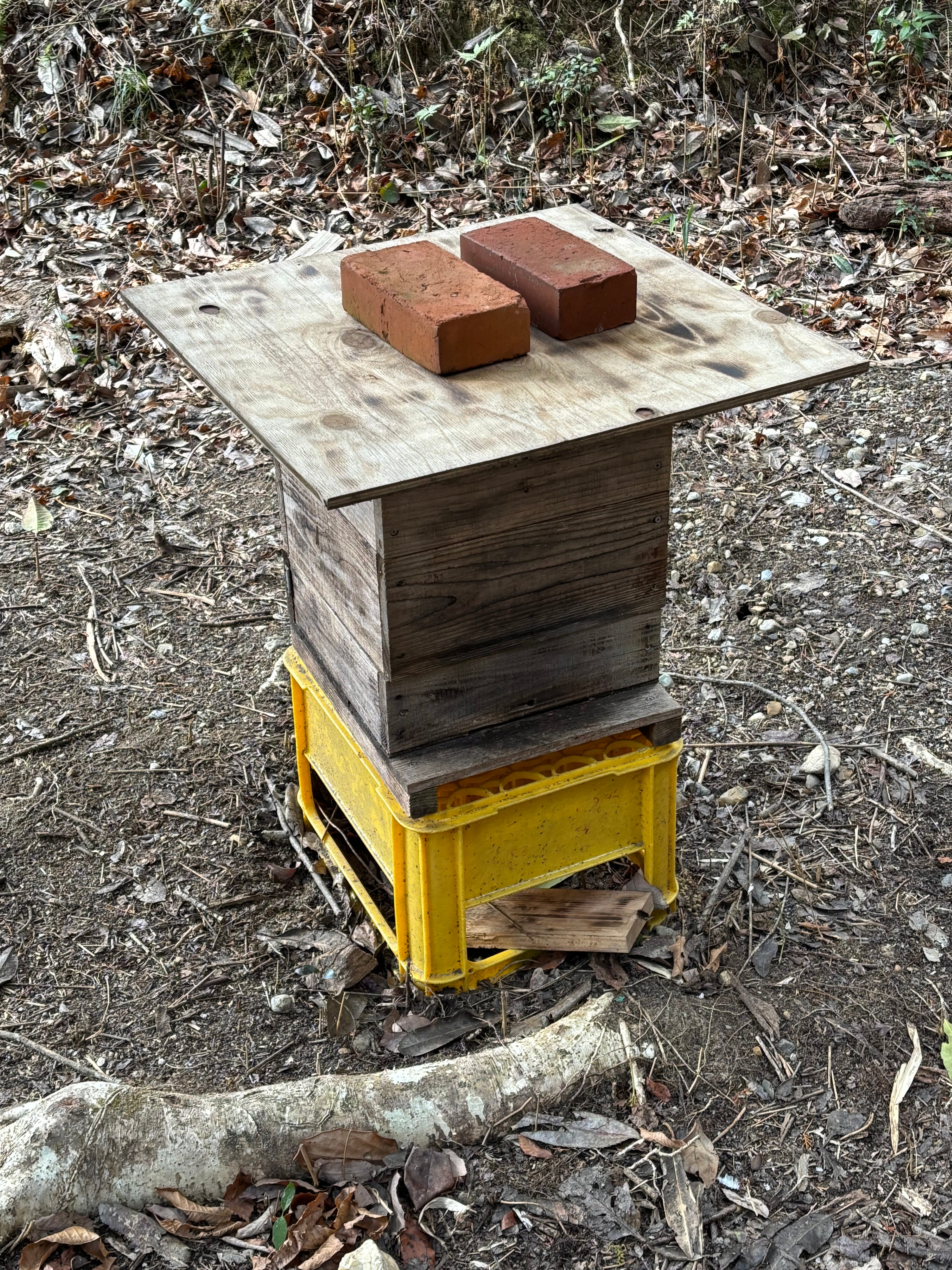
Beehive for local exotic honeybees in Ryukoku University satoyama forest.
Elsewhere, foreigners were leading the way. An Irish woman married to a Japanese architect had bought an old farmhouse by Lake Biwa. They had lain floorboards treated with lacquer in the traditional way. She had become interested in forest gardening while in Ireland but in Japan had found her calling working with organisations that were promoting satoyama ways of doing things. Sitting at her table, sharing coffee and delicious local pastries, she handed me a deep red bowl. It was remarkably light in the hands. She had lacquered this herself – over very thin, almost transparent, wood. Later, I visited the store in the central city where Tsutsumi Asakichi promotes the skills necessary to produce traditional Japanese lacquerware. Alongside the beautiful bowls and chopsticks there were examples of less traditional uses of lacquer including beautiful surfboards and even a bicycle. The store, called Und, is advertised as a “hub connecting nature, culture, and people” – satoyama in action. The urushi tree, that produces the lacquer, is becoming harder and harder to find, and the organization, Perspective, has started planting them in some borrowed state forest north of Kyoto city in Keihoku. This project, called “Forest of Craft” is tied to the Und store in the city. The trees take 10-15 years to grow large enough to be tapped for the meagre 150 grams of lacquer they can produce annually. They are not obviously capitalism compliant.
While satoyama is centered on forms of local knowledge and landscape, its influence is clearly spreading. Narisawa’s food has global acclaim, Tsing’s book is being taught around the world, research institutes such as the one at Ryukoku University, form part of a United Nations sponsored “Satoyama Initiative” that encourages satoyama practices around the world including in Papua New Guinea, Chengdu, China, and Tamil Nadu, villages outside of Rome, and in Baltimore County in Maryland, USA. Satoyama is becoming translocal, linking various kinds of local place through a set of environmental practices originally located in the space between the village and the mountains in a time before the dominance of fossil fuels.
[1] Anna Lowenhaupt Tsing, The mushroom at the end of the world: on the possibility of life in capitalist ruins (Princeton, NJ.: Princeton University Press, 2015).
Prof. Tim, I enjoy this new direction you are taking in your intellectual journey. It reads very exciting.
The local knowledges as you discussed earlier, are often slowly being written over a uniform globalized knowledge in many matters. I often ask and write, is there anything “indian” in Indian urban planning? The street is known as “theruvu” (in Malayalam), “rasta or sadak” (in Hindi), each of these words carrying many meanings of the streets as “place”, while the Indian Roads Congress or Planning Documents reduce all that to Streets with vocabularies heavily influenced from Urban Design Manuals prepared in US/UK.
The same goes with food I suppose, but given the diaspora of Indians around the world, I see how local knowledges about food/recipes etc are now being found globally often carried by immigrant families as a token of remembrance/memory of their land and then becomes part of the cuisine that place offers.