

Midway upon the journey of our life
I found myself within a forest dark,
For the straightforward pathway had been lost.
—Dante, The Divine Comedy
Two roads diverged in a wood, and I—
I took the one less traveled by,
And that has made all the difference.
—Robert Frost, “The Road Not Taken”
Dante and Robert Frost both found themselves in woods—Dante lost, with no way forward, and Frost with a choice to make as his path forked. In both cases routes, and the absence of routes, signify aspects of human meaning making. Life is figured as a journey along actual or hoped-for routes. They reveal the central role of routes and routing in the way we make sense of space and time. It is revealing that some of the root words for wilderness and wastelands suggest not so much the lack of settlements but rather the lack of routes or paths. The Latin word avium refers to a place without paths, while the Old English wēglæst refers to a “way-less place.”[i] The wilderness, the wastes, confront the traveler with a lack of routes. As such, it is unintelligible space. The first thing that is needed to make sense of the wild, or colonize nature, is a way, a path, a route. If we “lose our way,” we may find ourselves in “a forest dark.” Before space can be settled and before land can be cultivated, we must hack a way through. This suggests that the way that territory is claimed is not by marking its boundaries at the outset but by creating a network of routes that help the space to make sense.
Routes and routing are foundational to the power-laden process of human dwelling. The significance of routes and routing to both dwelling and power are also reflected in the etymology of the word route. In old French rute meant “road” or “way” or “path,” which was itself based on the Latin rupta, the feminine past participle of rumpere, “to break.” Rupta was used to describe a road opened by force—by breaking through a forest or wilderness for instance. It is linked to the word rupture. The violence of routes is a theme we will return to.
The mobilities of both citizens and vagabonds do not happen on an isotropic plain. They do not flow like a spilled liquid on an undifferentiated surface. The mobilities of citizens and vagabonds are routed, and the routes and channels through which they pass play an important role in differentiating one from another. There are citizen routes and vagabond routes, symbolized perhaps most grotesquely by the gradual erosion of the idea of “safe routes” to citizenship for asylum seekers and the precarious routes they must take instead—routes across the Mediterranean, the English Channel, or the Rio Grande, for instance. Here, the provision or denial of routes is most literally linked to the production of citizen and vagabond identities. The focus of this chapter, therefore, is on the way mobilities are routed and how these processes of routing are central to the production of kinetic hierarchies.
If we look at a standard atlas, we see both dots and lines. The dots tend to denote locations. The lines are either borders or routes (sometimes rivers, which are, of course, watery kinds of routes). The borders separate spaces while the routes, at first glance at least, connect them. Borders (and boundaries) have received a significant amount of theoretical and empirical attention in recent decades. There is a healthy field of border studies exploring how borders and bordering occur both at obvious borders (denoted by the lines on maps) and throughout everyday life, showing how borders both divide and in interesting ways bring hybrid forms of existence into being at various border spaces.[ii]Some of this work concentrates on techno-material borders such as those at the US–Mexico border, Israel/Palestine or at the edges of the European Union,[iii] while other work focusses on the border as a verb and the processes of bordering that happen everywhere in everyday life and in ways they impact different people in different ways according to race, gender, class, or bodily difference, for instance.[iv] Setting an agenda for a “critical border studies,” Noel Parker and colleagues note: “Borders are not only found at territorially identifiable sites such as ports, airports, and other traditional ‘border crossings’. Instead, they are increasingly ephemeral and/or impalpable: electronic, non-visible, and located in zones that defy a straightforwardly territorial logic, Examples include biometric identification to control movement and other technologies designed to track mobility such as social security data, records of financial transactions, spyware placing individuals in distinct groups of consumers, and the many other systems of surveillance.”[v]
***
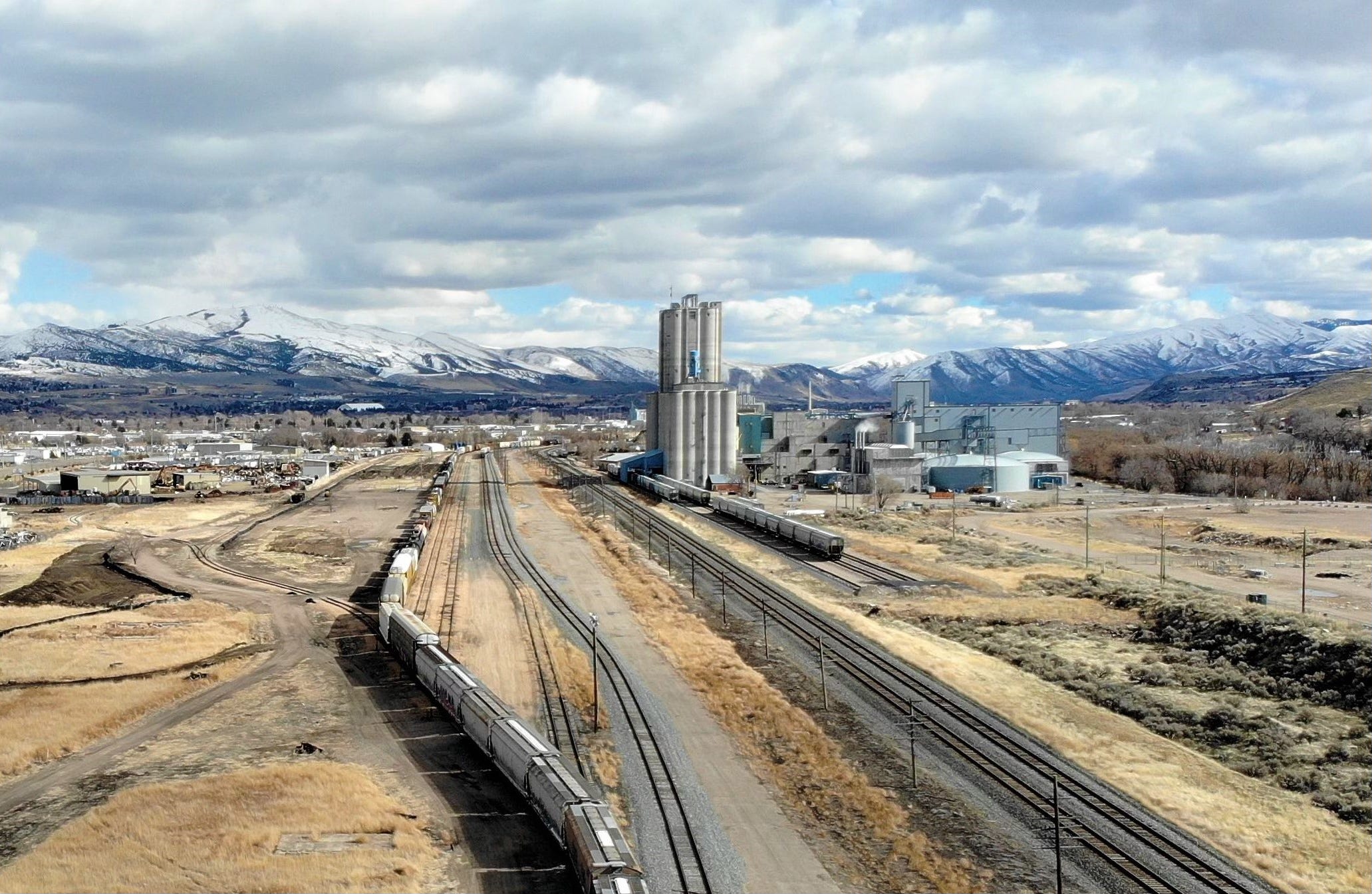
We started this chapter with the use of routes and the decisions they entail in the poems of Robert Frost and Dante. Another poem that explores the meaning of routes, in a more experimental mode, is “The Sundering U.P. Tracks,” the final part of American poet Edward Dorn’s The North Atlantic Turbine (1967). The route here is the route of the Union Pacific Railroad as it passes through the town of Pocatello, Idaho. The poem starts with the narrator feeling sorry for himself that Leroy McLucus has visited town and not asked to stay with him. Leroy McLucus was a noted Black photographer; the narrator was white. McLucus had
taken rooms
with the Reverend Buchanan
over in that part of town owned
by Bistline, the famous exploiter.[vi]
The poem quickly switches from the feeling of hurt to an explanation both of how McLucus got to Pocatello, and why he might have chosen to stay on the other side of town, a part of town, we might infer, on the “wrong side of the tracks.”
Every little bogus town
on the Union Pacific bears the scar
of an expert linear division.
The Union Pacific connects each of these “little bogus town[s]” while, at the same time, it divided them. The Union Pacific is indeed “sundering”—a word that means dividing. The poem cleverly plays on the traditional sense of the railroad as a uniting force—a route that represents manifest destiny and the binding of the United States into a coherent whole—with the sense of the railroad as this sundering force—this “expert linear division”—that creates the possibility of the “wrong side of the tracks.” The “Right of Way” is as much a border as a space of flow.
Each side of the shining double knife
from Chicago to Frisco
to Denver, the Cheyenne cutoff
the Right of Way they called it
and still it runs that way
right through the heart
Dorn refers to the work of the route as “rapacious geo-economic/surgery of Harriman.” E. H. Harriman was a financier and railroad tycoon, president of the Union Pacific Railroad as well as the Southern Pacific Railroad. The final words of the poem return to the racial divides that surround the Union Pacific:
You talk of color?
Oh cosmological America, how well
and with what geometry
you teach your citizens.
“The Sundering U.P. Tracks” uses the route of the Union Pacific to invert the conventional narrative of a route that binds the nation. Instead, it is a “shining double knife” and an example of “expert linear division.” While railroads were frequently tied to nationalistic discourses of unity that utilized the capacity of routes to connect, they were also material impositions on landscapes that served to divide communities in two as well as sites of intense land speculation that led to little bogus towns. If they were instances of geometry that taught citizens, then they were also instrumental in the production of vagabonds.
[i] I am grateful to Any Jeffs’s novel Wild for alerting me to these terms.
[ii] Gloria Anzaldua, Borderlands/La Frontera: The New Mestiza (Aunt Lute Books, 1987); Sandro Mezzadra and Brett Neilson, Border as Method, or, the Multiplication of Labor (Duke University Press, 2013); Chris Rumford, “Global Borders: An Introduction to the Special Issue,” Environment and Planning D: Society and Space 28, no. 6 (2010); Rachel Silvey, “Borders, Embodiment, and Mobility: Feminist Migration Studies in Geography,” in The Companion to Feminist Geography, ed. Lise Nelson and Joni Seager (Blackwell, 2005); M. B. Sparke, “A Neoliberal Nexus: Economy, Security and the Biopolitics of Citizenship on the Border,” Political Geography 25, no. 2 (2006); Chris Rumford, “Theorising Borders,” European Journal of Social Theory 9, no. 2 (2006); Emily Gilbert, “Leaky Borders and Solid Citizens: Governing Security, Prosperity and Quality of Life in a North American Partnership,” Antipode 39, no. 1 (2007).
[iii] Étienne Balibar, “Europe as Borderland,” Environment and Planning D-Society & Space 27, no. 2 (2009); Reece Jones, Border Walls: Security and the War on Terror in the United States, India and Israel (Zed Books, 2012).
[iv] Noel Parker and Nick Vaughan-Williams, “Lines in the Sand? Towards an Agenda for Critical Border Studies,” Geopolitics 14, no. 3 (2009).
[v] Parker and Vaughan-Williams, “Lines in the Sand?,” 583.
[vi] Edward Dorn, “The Sundering U.P. Tracks,” in Way More West: New and Selected Poems, ed. Edward Dorn (Penguin, 2007 [1967]), 88.
Very interesting Tim! I enjoyed this particular framing of "routes" and as planner we often talk only about mobility in terms of routes. And routes compress space into manageable parts making other mobilities diminished or impossible.