

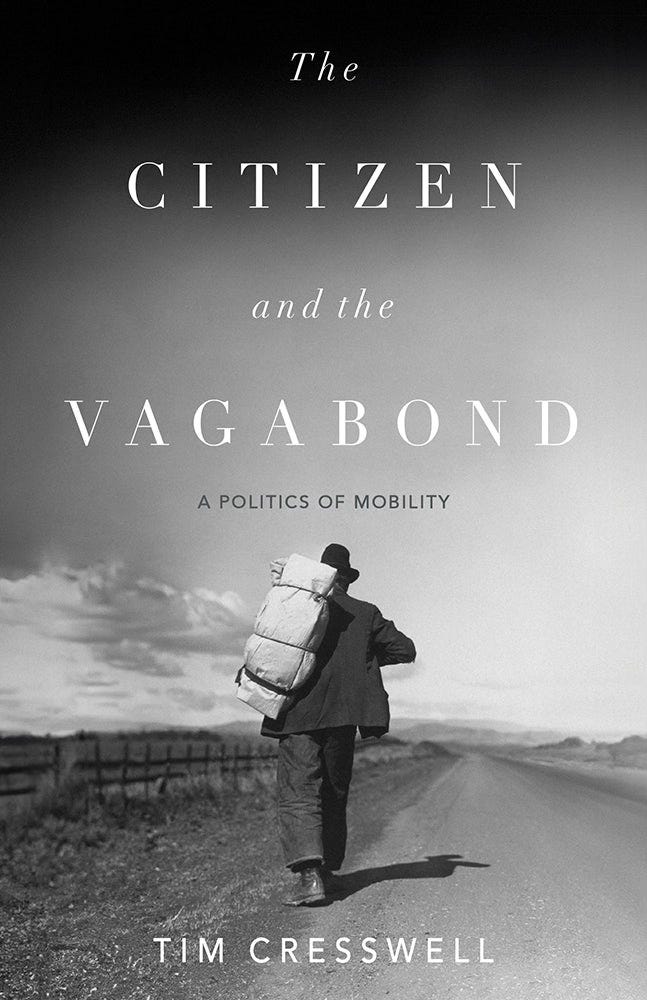
One place where the citizen and the vagabond were clearly differentiated according to an emerging politics of mobility was in late fifteenth-century Bern, Switzerland. It was around this time that inhabitants noticed bedraggled strangers arriving from elsewhere, begging for alms. The population of the city at the time was something under five thousand people—not a small village, but certainly small enough to be a knowable community. These new people were not known. They were wandering strangers carrying with them the scent of other places. Something needed to be done. In a fine-tuned evocation of the politics of mobile identities, the Bern Council of 1481 decided to expel all poor people who were not citizens of Bern (excluding religious pilgrims, who were asked to move on more politely). A later edict of 1483 reiterated the wish to be freed of the wandering poor, this time picking out those wandering beggars who spoke French for particular loathing. This was repeated in 1503, 1510, and 1515. As well as wayfaring paupers, Gypsies, pilgrims, and an assortment of other travelers were asked to leave—and to never return.[i] Clearly the Council of Bern was upset for over thirty years. They were upset by a group of people who are both poor and mobile. There had, of course, always been poor people in Bern and elsewhere. The problem was that these new wayfaring vagrants were not locatable. They produced anxiety because they were not legible within the clear hierarchies and geographies of medieval Europe. This was a world in which everyone had their place both geographically and socially. The poor were tied to the soil both through backbreaking labor and through law. They belonged to places, and it was the responsibility of those places to look after them. The Council of Bern, then, was responding to the mobility of the wandering poor. These were people without place (sans lieu) and “masterless men.”[ii]
All the edicts from 1483 to 1515 in Bern demanded the expulsion of the wandering poor. But as the number of these wanderers increased it became increasingly difficult to tell who they were. They also had to be differentiated from (sometimes) legitimate wanderers such as pilgrims and merchants. In a small town, where everyone is known, this is not difficult, but as more and more wanderers turn up, this becomes complicated. By 1527 the Council of Bern required all the deserving poor (that is, the poor who belonged to Bern) to wear badges identifying them as worthy of alms. The authorities kept lists of all those entitled to wear these badges. Forms of identification became a key tool in distinguishing between two kinds of people, two figures. One who belonged and deserved charity, and one who did not belong and could be moved on. These events are outlined by the historian Valentin Groebner in his book Who Are You?,where he charts how the very notion of identity in a modern sense was invented in fifteenth-century Bern, where the supposed threat of the new mobile people led to the poor being issued identity documents to prove they were worthy of alms.[iii] By the middle of the sixteenth century, similar ordinances could be found across Europe. From 1530, for instance, all those practicing beggars in England were supposed to carry a byllet (ticket) when begging for alms.[iv] In 1662, the English parliament passed the Poor Relief Act (also tellingly known as the Settlement and Removal Act). This set the stage for how the wandering poor were to be treated over the next 170 years. The Act set a number of tests to establish legal senses of belonging to particular parishes. Among the tests were place of birth, settled residence for over forty days, being hired for over a year and a day, or paying rent of taxes of over £10 per year. If someone could prove belonging, then they could claim poor relief from that parish. People who qualified for belonging were given settlement certificates. The logic for the act, and the separation of those who belonged and those who did not, is clearly laid out in the Act’s preamble:
Whereas by reason of some Defects in the Law, poor People are not restrained from going from one Parish to another, and therefore do endeavour to settle themselves in those Parishes where there is the best Stock, the largest Commons or Wastes to build Cottages, and the most Woods for them to burn and destroy; and when they have consumed it, then to another Parish, and at last become Rogues and Vagabonds, to the great Discouragement of Parishes to provide Stocks, where it is liable to be devoured by Strangers.[v]
Across medieval Europe, authorities responded to the presence of the wandering poor by differentiating the worthy (because local) poor from their wayfaring (and thus unworthy) counterparts by issuing forms of identification to those who are legitimate and refusing such identification to those who were not. Such a strategy also required forms of regulation in the form of people who could check identification and then punish or expel those who were too mobile. Punishment could be harsh, ranging from expulsion to branding and whipping. In 1571 those who were unfortunate enough to be caught in Bern after having been expelled were branded on the forehead with an iron cross.
In these early appearances of the vagabond, we can trace how this mobile subject was brought into being as a nightmare figure for a settled society—“the advanced troops or guerrilla units of post traditional chaos,” as Bauman has called them.[vi] The very word vagabond, and the associated word vagrant, both come from the Latin vagari, which means “wander.”[vii] Vagari is also the root of the word “vague” that arose in English in the sixteenth century as a word used to mean “uncertain” or “unclear.” The vagabond thus connects the idea of wandering to the idea of uncertainty. Certain things are things in their proper place. The lack of certainty associated with these new wanderers led to the creation of vagrancy laws that would travel across the Western world over the following centuries. We can see how particular kinds of mobile subjects were given identities through papers, badges, and other forms of identification that became necessary to the process of labeling. We can see how practices and technologies of surveillance were brought into being to keep the new enemy in view. We can see how the process of identification took the form of primitive biometrics via branding. All of these are reflected in aspects of life today—they continue to identify and bring into being suspicious, mobile subjects—dangerous travelers—alternative mobilities. The vagabond is there in the increasing number of antihomelessness laws that are proliferating in the twenty-first century.[viii] They are there in the biometric passport, and in the iris scanner and fingerprint reader. The vagabond continues to haunt the nightmares of the modern state as the threatening traveler—the unworthy wanderer practicing unwanted ingress.
In reactions to the newly mobile poor such as that in Bern, we see how new relations of mobility were being formed. Certain kinds of mobility were being framed both in relation to other forms of mobility and in relation to investments in place-boundedness. In Bern, if you had the right document, you possessed a form of identification that suggested you were worthy of alms and were allowed to beg. If you had no papers, then you did not. Groebner argued that the act of begging was central to the creation of what we now know as modern identity papers. Mobility was central here as it was only the mobile strangers arriving in ever-larger numbers as the systems of feudalism broke down that provoked the need to be certain who someone was. The emergence of a class of wandering poor went hand in hand with the emergence of the merchant as a figure at the heart of new forms of trade over long distances. The mercantile class depended on new forms of legitimate mobility and circulation. Our notions of belonging and citizenship changed as the scale of authority over correct and incorrect mobility moved from the city to the new nation-state. A key part of this was the establishment of identities in the literal sense of your ID—the papers that prove that you are you. Importantly this was not purely about individual identity but rather group membership. If you had the right papers, you belonged and could move freely—you inhabited the figure of the citizen. If you did not, your mobilities were immediately suspect and you inhabited the figure of the vagabond. You could be moved on or punished. This was one place where the identity of the citizen was being created through its differentiation from another mobile identity—that of the vagabond, or vagrant. This act of sorting the citizen from the vagabond based on geographical imaginations of place and mobility provides a starting point for an account of these two figures. In the rest of this chapter, I consider first, the citizen, and second, the vagabond.
***
About four hundred years after the edicts of Bern, two Black men, Jimmy Lee Smith and Milton Henry, were waiting for a car a friend had promised to lend them, one cold weekday morning on a street in downtown Jacksonville, Florida. They needed the car to apply for much-needed employment in a produce company. Smith worked off and on in the produce industry and also helped to organize a local Black political group. Henry was an eighteen-year-old high school student. On that morning Smith had no jacket, so they went briefly into a dry-cleaning shop in the hope of staying warm. They were soon asked to leave. Still fighting the cold, they walked up and down the street looking for their friend. Seeing Smith and Henry pass by their store several times, the store owners became wary of the two companions and called the police. Two police officers searched the men and found neither had a weapon. Nevertheless, they were arrested due to lack of identification on the two men and distrust concerning their story. They were arrested on a charge of vagrancy according to the Jacksonville ordinance code 26-57, which read:
Rogues and vagabonds, or dissolute persons who go about begging, common gamblers, persons who use juggling or unlawful games or plays, common drunkards, common night walkers, thieves, pilferers or pickpockets, traders in stolen property, lewd, wanton and lascivious persons, keepers of gambling places, common railers and brawlers, [405 US 156, 157] persons wandering or strolling around from place to place without any lawful purpose or object, habitual loafers, disorderly persons, persons neglecting all lawful business and habitually spending their time by frequenting houses of ill fame, gaming houses, or places where alcoholic beverages are sold or served, persons able to work per but habitually living upon the earnings of their wives or minor children shall be deemed vagrants and, upon conviction in the Municipal Court shall be punished as provided for class D offenses.[ix]
The case of Smith and Harris came before the US Supreme Court on December 8, 1971. They were named in Papachristou v. City of Jacksonville[x] as two of eight defendants who had been convicted in a Florida Municipal Court of violating the vagrancy ordinance. The conviction had been affirmed on appeal by a Florida Circuit Court. Their codefendants had been convicted on charges of vagrancy as well as “being a common thief,” “loitering,” and “prowling by auto.”[xi] The Supreme Court overthrew the convictions on the grounds that the ordinance was too vague and encouraged arbitrary arrests at the hands of an unfettered police force. Their decision was informed by a working knowledge of the history of vagrancy law that had been imported wholesale from medieval England:
The history is an often-told tale. The breakup of feudal estates in England led to labor shortages which in turn resulted in the Statutes of Laborers, designed to stabilize the labor force by prohibiting increases in wages and prohibiting the movement of workers from their home areas in search of improved conditions. Later vagrancy laws became criminal aspects of the poor laws. The series of laws passed in England on the subject became increasingly severe. . . . The conditions which spawned these laws may be gone, but the archaic classifications remain.[xii]
In fact, vagrancy laws had been used in the United States for over 150 years. Papachristou v. City of Jacksonville had become a well-known case because it pointed out the absurdity and archaic nature of such laws that effectively allowed police to decide what kinds of activities would fit the idea of “vagrant.” Vagrancy was a crime of identity rather than identification of a particular action. Vagrancy laws, from the sixteenth century on, “aimed to control “undesirable” groups who threaten to destabilize local communities. Historically, these statutes have ensured that society’s most disadvantaged groups are kept within limits defined by and acceptable to majority groups.”[xiii]
Perhaps the most notorious use of vagrancy laws imported from Elizabethan England to the United States was their use to reenslave Black people in the years following the abolition of slavery. The so-called Black Codes or Black Laws were used across the South during the Jim Crow era, following the introduction of the Thirteenth Amendment to the US Constitution, to arrest people wandering around without visible means of support and unable to give a good account of themselves. In most instances this meant recently freed Black people.[xiv] The Black Codes included versions of vagrancy laws that had been in force since the origin of the North American colonies. They were simply reconfigured for the Jim Crow era, where White supremacy felt threatened by newly free and newly mobile Black people. Notably, the punishment associated with the Black Codes were essentially slavery. In Kentucky, Black vagabonds could be bound to the highest bidder for a year’s service. Seven other states instituted similar processes for “convict leasing” or, as Douglas Blackmon called it, “slavery by another name.”[xv] Between 1893 and 1909 every Southern state except Tennessee introduced new versions of vagrancy laws in ways that specifically targeted Black people.[xvi] Vagabondage was very much part of racial capitalism as White bosses sought to ensure the availability of cheap or free Black labor across the South.
The Supreme Court decision in Papachristou v. City of Jacksonville in 1972 appeared to signal an end to the racist use of vagrancy laws. In the years following 1972, however, most states and Canada abolished vagrancy laws and replaced them with new codes specifying particular kinds of behavior most often associated with the homeless. The Safe Streets Acts of Ontario and British Columbia passed in 1999, for instance, criminalized “aggressive” soliciting and the unsafe disposal of needles and condoms.[xvii] In effect they reintroduced vagrancy laws through the back door. “Loitering” became a new kind of racialized crime. The Anti-Racism Daily reports how in California, an act was passed in forbidding “loitering with the intent to commit prostitution,” which effectively targeted Black and trans women due to modes of dress or their use of public street space. The article continues: “Three white men murdered Ahmaud Arbery in Georgia in 2020. They were suspicious that Arbery was jogging through their neighborhood: that is, ‘strolling about in idleness,’ or loitering. Philadelphia police arrested 15,552 young people for curfew or loitering violations over just three years. 85% of those arrested were Black youth, though just 42% of Philadelphians are Black. From coast to coast, look into the enforcement of bans on loitering and racism appears.”[xviii] Back in California, descendants of the vagrancy laws and Black Codes were also being used to address gang violence by effectively making membership in gangs a crime in the absence of criminal acts that were already on the books. Among the activities these civic ordinances outlawed was the right for people identified as gang members to socialize in public. People identified as gang members almost always meant Black or Brown people. As Gary Stewart has argued, “Anti-gang injunctions share with postbellum vagrancy ordinances a repressive effect that stamps minority communities with badges of inferiority”[xix] and “Although not framed in the explicitly racial terms of the postbellum Black Codes, anti-gang civil injunctions share with those earlier laws the effect of stigmatizing minority communities and maintaining white hegemony.”[xx]
Similar uses of vagrancy statutes occurred in the West Indies, as Demetrius Eudell has shown regarding the laws surrounding the end of slavery that made departure from the estates on which they had been slaves on prohibitively difficult.[xxi] Lisa Lowe has shown how vagrancy laws were used in Hong Kong in the mid-nineteenth century by colonial governments to prosecute the dislocated peasants from China who were labeled as outcast transients. “Vagrancy” she writes, “was an available category through which the colonial state could manage the Chinese population by disciplining and dividing “good” workers from “bad” vagrant.”[xxii] As with the edicts of Bern, the twenty or so ordinances passed by the second Governor of Hong Kong, Sir John Francis Davis, used techniques of governance including registration lists and passes to control the mobility of the vagabonds—in this case, Chinese people—both within Hong Kong and across its borders. The Chinese, for instance, “were required to carry a registration card at all times and faced imprisonment or deportation if not registered.”[xxiii] Lowe shows how the ordinances were used to “legislate Chinese colonial difference”[xxiv] and did this largely through the governance of mobilities.
In all these cases, and particularly in the attempt to define Smith and Harris as vagrants, the process of definition is conceptually and practically linked to the status of the mobile figure of the citizen. While vagabonds are those who move about and are unable to give a satisfactory account of themselves, citizens are those who are lawfully entitled to move, both within the space they are citizens of and across borders according to international law. Moving freely, or being stopped, are the attributes of citizens and vagabonds, respectively. They exist in relation to each other. In so far as literal citizens are not able to move freely either within the space they are citizens of or across its borders into other spaces, then they are experientially and politically something less than citizens. The experience of Smith and Harris, and the experience of countless other Black and Brown people, reveal how citizenship as a legal identity and citizenship as lived are often at odds. In addition to racialized others, homeless people, gypsies and travelers, LGBTQ+ people, disabled people, and many others are frequently treated in ways that make citizenship a dubious notion.
[i] Valentin Groebner, Who Are You?: Identification, Deception, and Surveillance in Early Modern Europe (Zone Books, 2007).
[ii] A. L. Beier, Masterless Men: The Vagrancy Problem in England 1560–1640 (Methuen, 1985).
[iii] Groebner, Who Are You?
[iv] Frank Aydelotte, Elizabethan Rogues and Vagabonds (Clarendon, 1913); Groebner, Who Are You?
[v] Full text of act available at https://www.workhouses.org.uk/poorlaws/1662act.shtml (accessed February 19, 2024)
[vi] Zygmunt Bauman, Life in Fragments: Essays in Postmodern Morality (Blackwell, 1995), 94.
[vii] “Vagabond” and “vagrant” are used interchangeably throughout this text.
[viii] Don Mitchell, “The Annihilation of Space by Law: The Roots and Implications of Anti-Homeless Laws in the United States,” Antipode29, no. 3 (1997).
[ix] Jacksonville Ordinance Code 26–57 cited in Papachristou v. City of Jacksonville 405 US ( 1972 ) ( 156–7 )
[x] Papachristou v. City of Jacksonville, 405 US 156 (1972)
[xi] “Prowling by auto” is not listed in Jacksonville’s vagrancy statute, but the Florida District Court of Appeal had construed this as a variant of “wandering or strolling from place to place” in a previous case.
[xii] Papachristou v. City of Jacksonville, 405 US 156 (1972 ) (161–2).
[xiii] Gary Stewart, “Black Codes and Broken Windows: The Legacy of Racial Hegemony in Anti-Gang Civil Injunctions,” The Yale Law Journal 107, no. 7 (1998): 2249.
[xiv] Douglas A. Blackmon, Slavery by Another Name: The Re-enslavement of Black Americans from the Civil War to World War II (Anchor Books, 2009); Joseph A. Ranney, In the Wake of Slavery: Civil War, Civil Rights, and the Reconstruction of Southern Law (Praeger, 2006).
[xv] Blackmon, Slavery by Another Name.
[xvi] Stewart, “Black Codes and Broken Windows.”
[xvii] Catherine T. Chesnay, Céline Bellot, and Marie-Ève Sylvestre, “Taming Disorderly People One Ticket at a Time: The Penalization of Homelessness in Ontario and British Columbia,” Canadian Journal of Criminology and Criminal Justice 55, no. 2 (2013); Nicholas Blomley, “How to Turn a Beggar into a Bus Stop: Law, Traffic and the ‘Function of the Place’,” Urban Studies 44, no. 9 (2007); Kristin O’Brassill-Kulfan, Vagrants and Vagabonds: Poverty and Mobility in the Early American Republic (New York University Press, 2019).
[xviii] Andrew Lee, “The Jim Crow Roots of Loitering Laws,” Anti-Racism Daily (May 31, 2022). https://web.archive.org/web/20240112173353/https://the-ard.com/2022/05/31/the-jim-crow-roots-of-loitering-laws/.
[xix] Stewart, “Black Codes and Broken Windows,” 2251.
[xx] Stewart, “Black Codes and Broken Windows,” 2278.
[xxi] Demetrius Lynn Eudell, The Political Languages of Emancipation in the British Caribbean and the U.S. South (University of North Carolina Press, 2002).
[xxii] Lisa Lowe, The Intimacies of Four Continents (Duke University Press, 2015), 121.
[xxiii] Lowe, The Intimacies of Four Continents, 124.
[xxiv] Lowe, The Intimacies of Four Continents, 124.