

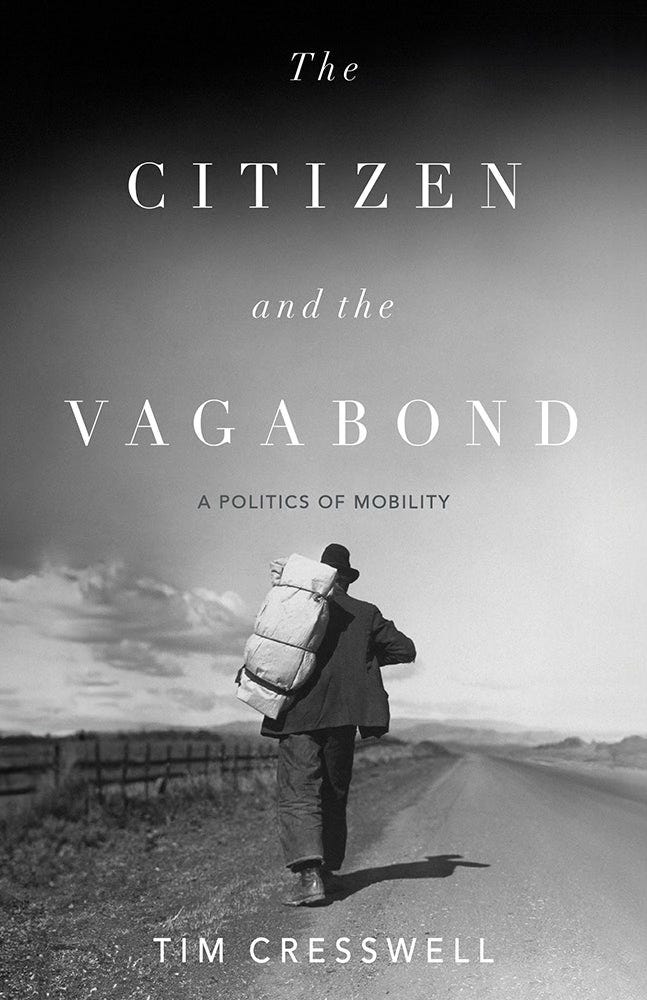
My new book, The Citizen and the Vagabond: A Politics of Mobility is winging its way to me from the University of Minnesota Press and will be officially published on March 17th. What follows are the first few paragraphs as a set up for the book.
On 23rd March 2020, I watched with millions of others as Prime Minister Boris Johnson announced to the nation that we would enter a period of “lockdown” in response to the rapid spread of a novel coronavirus SARS- CoV-2that was causing the disease newly named COVID-19. We were told to stay at home. Workplaces, schools, and all shops deemed “non-essential” would be closed.People were allowed to leave home for food shopping and for medical reasons as well as for brief walks close totheir homes for the purpose of exercise. With some variations over time, this lockdown would stay in place until 4thJuly. A second lockdown was announced on 5th November as the hospitals began to fill up with COVID-19 cases and it was feared the National Health Service (NHS) would be overwhelmed. Before March 2020 I, along with many citizens of the UK, had watched as similar lockdowns had been introduced first in Wuhan, China, and then throughout the world. Lockdowns would continue to be introduced around the world throughout 2020 and 2021.
For a brief period, following Johnson’s announcement, a different world emerged - one that had lain dormant beneath the bustle of everyday life. Photographs and drone videos appeared on social media feeds showing streets that were once choked with traffic suddenly empty and silent. Stories emerged of wildlife, once banished, appearing in unlikely places. A wild herd of 122 Kashmiri goats took over the town square in Llandudno, Wales, wild boar took to the streets of Haifa, Israel, and just around the corner from our house in Edinburgh, a deer was photographed strolling down the main road outside the branch of Nero’s coffee shop. The most regular form of urban mobility, thejourney to work and back, ceased to exist for many of us who became used to working from home. The hour we were allowed for a walk became a precious part of the day and the significance of “going for a walk” was amplified. During these walks, new codes and gestures emerged thanks to the newly learned practice of “social distancing”. People began to engage in polite little swerves accompanied by a knowing nod of the head to acknowledge botheach other and the weirdness of it all. Condensation trails disappeared from the sky as flights were dramatically cut.Global passenger number decreased by 60%, a city of 2.5 million no longer in the air.
People began to remark on the possibility of a “new normal” as some aspects of the lockdown, in a generally well-to-do place like Edinburgh, seemed appealing. The local city council took the opportunity to reimagine what streets might look like if more space was given over to pedestrians and cyclists. The “Spaces for People” initiativesaw sidewalks widened, areas of road marked off with bollards and cones, and whole streets given over to pedestrians. Bus lanes that had previously been designated for rush hour only, became all day bus lanes. Elsewhere in Europe, street spaces were re-engineered to take account of the “new normal”. In Milan, for instance,22 miles of street space was reallocated from cars of pedestrians and cyclists. The plan was not simply to recognize the realities of mobility patterns under lockdown but to change mobilities permanently in what has traditionally been a congested city with high levels of air pollution. The Deputy Mayor of Milan, Marco Granelli, said that “[w]e worked for years to reduce car use. If everybody drives a car, there is no space for people, there is no space to move, there is no space for commercial activities outside the shops. Of course, we want to reopen the economy, but we think we should do it on a different basis from before. We think we have to reimagine Milan in the new situation. We have to get ready; that’s why it’s so important to defend even a part of the economy, to support bars, artisans and restaurants. When it is over, the cities that still have this kind of economy will have an advantage, and Milan wants to be in that category.”1Back in the UK, the government decided that people without homes should be provided with shelter, paid for by the government. The unhoused were taken off the streets and taken to hotels that no longer had any tourists to service. One of the most remarkable of many remarkable visualizations that appeared in the media in the early days of the pandemic was a map from NASA showing the incredible lowering of air pollution over the Wuhan area since the onset of the stringent lockdown there.2 The shrinking red blob represented a 63% reduction in Nitrogen Oxide concentrations which, itself, may have prevented over 10,000 premature deaths across China by April 2020.3
The strange “new normal” revealed what it was possible to accomplish when the global community was faced with a crisis. Roads could be reclaimed for people, air travel could be slashed, pollution and its attendant healthproblems could be eradicated seemingly overnight, and the unhoused could be provided with shelter. It led some of us to wonder why other crises had not been tackled with such urgency. There was, as Mimi Sheller has shown, a climate crisis, an urbanization crisis, and a refugee crisis – all entangled and implicated in each other.4 Each was likely to kill far more people than the COVID crisis. And yet governments had not reacted with anywhere near theurgency to any of these. Perhaps the COVID crisis would show exactly what governments were capable of?
Alongside the strangely utopian moments of the pandemic other, uglier, aspects started to become clear. Those of us who could work from home were serviced by a workforce, often in the gig economy and precariouslyemployed on zero-hour contracts, who could not stay at home. For me, and people like me, to be comfortably immobilized, an army of workers had to be franticly on the move. Demographically, the people servicing my stay-at-home existence were quite different. Many were people of color. This was also true of the health care and social care workers who worked in the most dangerous environments. At the same time, stories emerged of the super wealthy getting in their private jets and heading for island homes or escape bunkers in order to bypass both the virus and the lockdown rules. The reason unhoused people were suddenly provided places to stay was not for their own benefit, but to stop the spread of the disease to those of us who had homes. They had become a public health risk. Elsewhere in the world the efficacy of lockdowns was even more questionable. In India, a lockdown was imposed overnight on population of over a billion. There was no way to “socially distance” on the outskirts of massive cities. Hundreds of thousands of migrant and casual workers were asked to return home when home was hundreds of miles away and there was no transport. In any case, more people were dying from tuberculosis and other persistent diseases of poverty. Refugees in camps on the Greek isle of Lesbos remained crowded into camps with only a few standpipes as sources of water. In the United States, Trump’s administration layered a fear of COVID on to a generalized fear of immigrants to further clamp down at the US – Mexico border as well as to feed Sinophobia through references to the “China” or “Wuhan” virus.
In the fall semester of 2020 I was teaching my Geographies of Mobility course. It quickly became evident to the students that almost everything we were discussing in the course was being illustrated in real time across the world in COVID related ways. The course, like many others, became a COVID course in more ways than one. The pandemic was one massive “teachable moment”. At local, national, and global levels, while lockdowns made clear the possibility of other, better, worlds, they also revealed the persistence of the importance of mobility to the production and maintenance of social hierarchies. They underlined the central theme of this book - the importance of the politics of mobility to our understanding of processes of power.
_________________________________________________________________________
1 Laura Laker, “Milan announced ambitious scheme to reduce car use after lockdown,” The Guardian (Manchester), 21 April 2020,https://www.theguardian.com/world/2020/apr/21/milan- seeks-to-prevent-post-crisis-return-of-traffic-pollution.
2 https://www.bbc.co.uk/news/world-asia-51691967 (accessed 1 June, 2023).
3 Matthew A Cole, Robert J R Elliot, and Bowen Liu, The impact of the Wuhan Covid-19 lockdown on air pollution and health: a machinelearning and augmented synthetic control approach, University of Birmingham Department of Economics (2020).
4 Mimi Sheller, Mobility justice: the politics of movement in the age of extremes (London: Verso, 2018).
Congratulations on this book being published, Tim.
It must have been fascinating to do the research.